Why Highly Creative People Often Score Low in Conscientiousness
 Yaro Pry··5 min read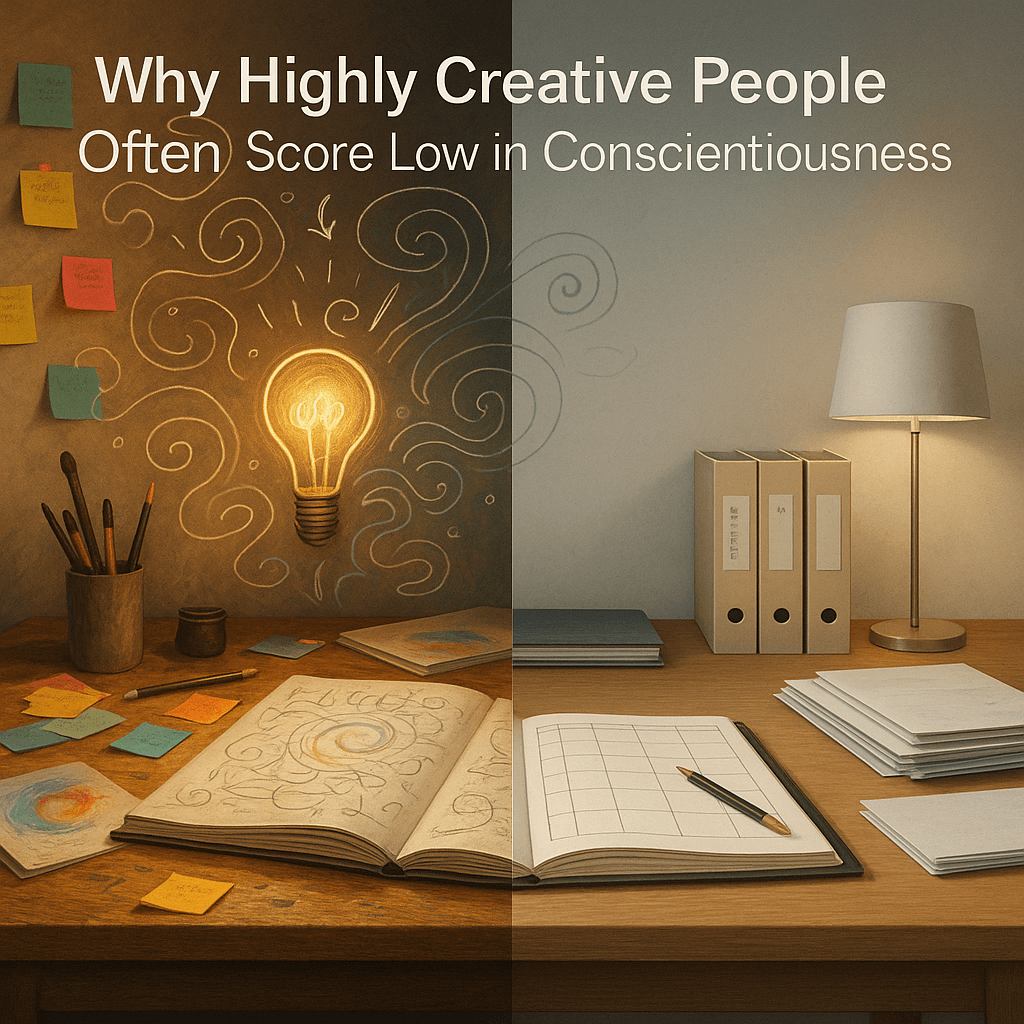
Creativity has a reputation problem. People love the idea of the “creative genius” - bold, imaginative, original. But peek behind the curtain and you’ll often find something less glamorous: messy desks, missed deadlines, half-finished notebooks stacked like geological layers of ambition. So why do highly creative people often score low in conscientiousness? Is it laziness? Lack of discipline? A flaw in character? Not quite. The answer is more nuanced - and honestly, far more interesting.
What Conscientiousness Actually Means
Before pointing fingers at the dreamers, let’s clarify what conscientiousness measures. In personality psychology - especially within the Big Five framework (also called OCEAN) - conscientiousness reflects traits like:
- Organization
- Reliability
- Self-discipline
- Goal orientation
- Attention to detail
High scorers plan ahead. They make lists and, importantly, follow them. They meet deadlines. They color inside the lines. Lower scorers? They’re more spontaneous. Flexible. Sometimes chaotic. They may struggle with routine, structure, or rigid systems. Sounds simple, right? Here’s the twist.
Creativity Thrives on Cognitive Freedom
Creativity is not just about talent. It’s about cognitive flexibility - the ability to jump between ideas, connect distant concepts, and tolerate ambiguity. Conscientiousness, at high levels, often prefers order and predictability. Creativity, on the other hand, feeds on uncertainty. Think of the mind like a garden. Highly conscientious individuals plant in straight rows. They label everything. They prune regularly. Creative thinkers? They let vines grow wild. Some plants tangle. A few die. But every now and then, something rare blooms that would never survive in a perfectly trimmed space. That “mess” isn’t always dysfunction. Sometimes it’s fertile ground.
The Tension Between Structure and Imagination
Here’s where things get interesting. Structure creates efficiency. Structure also creates limits. Highly creative individuals often resist rigid systems because those systems narrow possibility. When someone is brainstorming, strict organization can feel like putting guardrails on a racetrack before the car has even started moving. And that resistance can show up on personality assessments as lower conscientiousness. It’s not that creative people can’t be disciplined. It’s that their mental energy often prioritizes ideation over execution. Two different skill sets. Two different rhythms.
Research Supports the Trade-Off
Multiple studies exploring the Big Five traits show a consistent pattern: openness to experience strongly correlates with creativity. Conscientiousness? The relationship is weaker - and sometimes even slightly negative. Why? Because:
- High openness encourages exploration of unconventional ideas.
- Lower conscientiousness allows rule-bending and experimentation.
- Creative breakthroughs often require abandoning plans midway.
Imagine trying to invent something radically new while obsessing over keeping your desk spotless. Possible? Sure. Common? Not really. The brain has limited bandwidth. When cognitive resources go toward imagination and novelty-seeking, less energy may remain for structured follow-through. It’s a trade-off, not a defect.
The Myth of the “Unproductive Artist”
Here’s a hot take: society romanticizes creative chaos but rewards structured output. Employers, schools, institutions - they measure performance through reliability and consistency. Conscientiousness becomes the gold standard because it predicts stable results. Meanwhile, creativity often produces uneven output. Bursts of brilliance. Followed by droughts. That pattern doesn’t always fit into corporate spreadsheets. But low conscientiousness does not equal incompetence. It often signals a different motivational architecture. Some creative individuals operate in intense waves:
- Hyperfocus for hours or days
- Sudden insight at unexpected moments
- Periods of reflection that look like inactivity from the outside
From a distance, it may resemble procrastination. From the inside, it feels like incubation. Big difference.
Intrinsic Motivation Plays a Huge Role
According to Self-Determination Theory - one of the leading psychological models used in modern assessments - intrinsic motivation drives behavior far more powerfully than external pressure. Highly creative people often depend on internal curiosity rather than external deadlines. If they care deeply about a project? They’ll obsess over it. If they don’t? No checklist in the world will generate momentum. That selective drive can lower average conscientiousness scores while preserving intense commitment in areas of passion. It’s not inconsistency. It’s targeted energy allocation.
Emotional Sensitivity and Idea Generation
Creative personalities frequently show higher emotional sensitivity - a trait connected to both openness and emotional intelligence. Emotions fuel art, writing, design, innovation. They also complicate structured task completion. Picture trying to maintain a strict schedule while feeling everything at full volume. It’s like driving a race car with the radio blasting multiple stations at once. Stimulating. Distracting. Lower conscientiousness may reflect difficulty regulating mood-based productivity swings, not lack of capability.
Understanding the Full Personality Picture
One trait alone never tells the whole story. This is why comprehensive psychometric platforms matter. A single dimension - like conscientiousness - can’t define someone’s potential or performance. Platforms such as lifematika.com integrate eight validated psychological frameworks into one streamlined assessment. In roughly 15 minutes and 95 questions, users receive a detailed report covering:
- Big Five traits including conscientiousness and openness
- Jungian cognitive styles
- DISC behavioral patterns
- Character strengths
- Core personal values
- Motivational drivers
- Emotional intelligence
The result isn’t a label. It’s a map. And for creative individuals who worry about scoring “low” in structured traits, that broader analysis often reveals powerful compensatory strengths. Sometimes extraordinary imagination simply lives alongside flexible organization. That’s not failure. That’s design.
Can Creative People Increase Conscientiousness?
Short answer: yes. Long answer: with strategy, not self-judgment. Personality traits show relative stability, but behavior can absolutely change. Here’s what tends to work well for imaginative minds:
1. Externalize Structure
Instead of forcing internal discipline, use tools. Calendars. Timers. Accountability partners. Think of structure as scaffolding around a building under construction. It doesn’t replace creativity - it protects it.
2. Work in Creative Sprints
Short bursts of focused effort often outperform long rigid schedules for idea-driven personalities. Forty-five minutes. Break. Repeat. Rhythm matters more than rigidity.
3. Separate Idea Generation from Execution
Brainstorm wildly first. Organize later. Trying to do both simultaneously can suffocate innovation.
4. Align Tasks With Core Values
When projects connect deeply with personal meaning, follow-through improves naturally. Motivation becomes internal rather than forced. Understanding one’s values - something measured in comprehensive personality assessments - can dramatically improve consistency.
The Hidden Strength in Lower Conscientiousness
Here’s something rarely discussed. Lower conscientiousness can allow:
- Higher tolerance for risk
- Greater adaptability
- Willingness to pivot quickly
- Openness to unconventional methods
In rapidly changing industries - tech, media, entrepreneurship - that flexibility can outperform strict rule-following. Imagine trying to innovate while obsessing over perfect procedures. You’d never launch. Creative disruption often begins where structure loosens.
It’s About Balance, Not Superiority
This isn’t a battle between organized planners and imaginative wanderers. High conscientiousness builds systems. High creativity redesigns them. The world needs both. The real advantage comes from awareness. When individuals understand their personality architecture - strengths, blind spots, motivational drivers - they can build environments that amplify what works and compensate for what doesn’t. That’s where science-backed self-discovery tools become powerful. Not as judgment machines, but as mirrors. Because here’s the truth: a low score in one trait never defines capability. It simply highlights a tendency. And tendencies can be managed.
Final Thought
Highly creative people often score lower in conscientiousness because imagination requires cognitive freedom. Structure narrows possibilities. Creativity expands them. Sometimes those forces clash. But friction creates sparks. And sparks? They start revolutions. The key isn’t forcing every imaginative mind into rigid productivity molds. It’s understanding how their psychological profile operates - then building systems that honor both innovation and execution. That balance is where potential turns into impact. And that’s far more compelling than a perfectly organized desk.