The Evolution of Personality: Why Traits Exist
 Yaro Pry··5 min read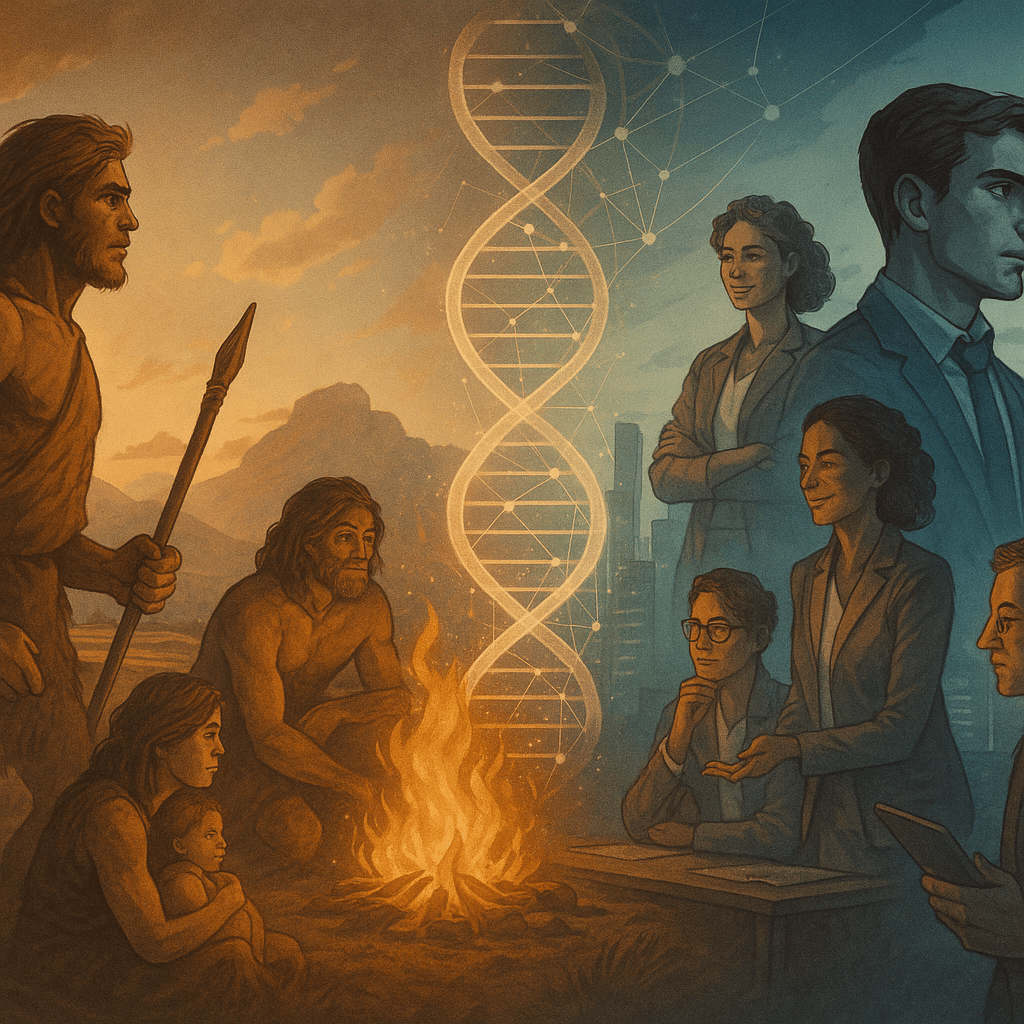
Why do some people crave the spotlight while others would rather sit quietly in the corner with a book? Why does one person leap into risk like it’s a swimming pool in July, while another tests the water with a cautious toe? Personality isn’t random. It isn’t decorative. It isn’t some cosmic accident sprinkled on humans for variety. Personality traits exist because they helped us survive. And if you ask many psychologists today, they still do. Let’s unpack that.
Personality Traits Are Not Flaws - They’re Survival Tools
Imagine early humans standing at the edge of a dense forest. Night approaching. Strange sounds in the distance. Someone needed to be bold enough to explore. Someone else needed to be cautious enough to say, “Hold on. That noise doesn’t sound friendly.” Different traits served different purposes. And tribes that had a mix? They lasted longer. This is the core idea behind the evolution of personality. Traits like extraversion, conscientiousness, openness, and emotional sensitivity didn’t just appear for social drama. They were adaptive strategies. Think of personality like a toolbox. - Some tools are loud and visible - like a hammer. - Others are subtle and precise - like a measuring tape. - None are useless. They’re just built for different jobs. Modern psychology backs this up. Models like OCEAN - often called the Big Five personality traits - categorize human behavior into five broad dimensions. These aren’t labels. They’re patterns shaped by both biology and environment over thousands of years. And here’s the twist: no single trait is universally superior. Sounds simple, right? It isn’t.
The Big Five and Evolutionary Advantage
The Big Five model includes: 1. Openness to Experience 2. Conscientiousness 3. Extraversion 4. Agreeableness 5. Neuroticism Each of these traits has evolutionary logic behind it.
Openness: The Innovators
Highly open individuals tend to explore, experiment, imagine. In ancient environments, they were the inventors. The ones who wondered, “What if we try cooking this root instead of eating it raw?” Curiosity led to innovation. Innovation improved survival. But too much openness? Risky. Not every unknown berry is safe. Balance matters.
Conscientiousness: The Planners
Structured, disciplined individuals helped groups prepare for winter, store food, and maintain order. They noticed details others ignored. Without conscientious members, early communities would have been chaotic. Yet extreme rigidity could slow adaptability. Again - trade-offs.
Extraversion: The Connectors
Extraverts formed alliances, negotiated with neighboring tribes, and strengthened group cohesion. Social bonding increased protection. But constant risk-taking and dominance behaviors could also spark conflict. Every strength has an edge.
Agreeableness: The Peacemakers
Cooperation is a survival superpower. Agreeable individuals reduced internal friction and increased trust. Groups with high internal cooperation generally outperformed those stuck in constant conflict. Still, too much compliance could invite exploitation.
Neuroticism: The Alarm System
Here’s a hot take - neuroticism isn’t a flaw. It’s an early warning system. Heightened sensitivity to threats kept ancestors alert. If someone constantly scanned for danger, they were more likely to notice the predator hiding in tall grass. In modern society, that same sensitivity can translate into anxiety. But evolution doesn’t update software quickly. It builds for survival, not comfort.
Personality Variation Keeps Societies Stable
Have you ever noticed how teams fail when everyone thinks the same way? Organizations crumble when creativity is absent. Families struggle when no one takes initiative. Friend groups implode when conflict resolution is missing. Human diversity in temperament acts like ecological diversity in nature. Monocultures collapse. Diverse systems endure. This is why personality variation persists across generations. If a trait were truly useless, evolution would have filtered it out. Instead, we see stable distributions of traits worldwide. That’s not coincidence. That’s design through natural selection.
Modern Psychology Meets Ancient Wiring
Here’s where things get interesting. Today, survival doesn’t look like hunting mammoths. It looks like navigating careers, relationships, and personal growth. The environment changed. Our wiring? Not as much. That’s why understanding personality is no longer a philosophical hobby. It’s a practical advantage. Scientific psychometric platforms like lifematika.com combine eight major psychological frameworks into a single 95-question assessment. In about 15 minutes, users receive a detailed personality analysis grounded in peer-reviewed research. No registration. Instant report. Fully confidential. Why does that matter? Because most people walk through life using tools they don’t fully understand. Lifematika integrates: - OCEAN - Big Five traits - Jungian typology and cognitive functions - DISC behavioral styles - VIA character strengths - Self-Determination Theory - Schwartz’s values theory - Emotional intelligence metrics - Motivational level analysis That’s not a surface quiz. It’s a layered psychological mirror. And mirrors can be uncomfortable. But they’re useful.
Why Traits Persist - Even When They Seem Inconvenient
Have you ever wondered why certain personality traits feel like obstacles in modern life? For example: - Highly sensitive individuals overwhelmed by fast-paced workplaces - Highly dominant personalities clashing in collaborative cultures - Deep thinkers struggling in environments that reward speed over reflection It’s tempting to call these mismatches “weaknesses.” They’re not weaknesses. They’re context misalignments. A cactus thrives in a desert. Move it to a rainforest and it struggles. The plant isn’t defective. The environment shifted. The same applies to temperament. Evolution shaped traits for flexible group survival, not corporate performance reviews. Understanding this changes everything.
The Role of Emotional Intelligence in Personality Evolution
Emotional intelligence deserves special attention here. Early humans depended on reading subtle facial expressions, tone shifts, and body language. Misreading emotion could mean social exclusion - and exclusion, historically, was dangerous. Belonging equaled protection. Modern assessments now measure emotional regulation, empathy, and interpersonal awareness because these capacities remain critical. They influence leadership, romantic relationships, parenting, and negotiation. They are ancient skills wearing modern clothes.
Motivation, Values, and the Hidden Drivers of Behavior
Personality isn’t just about visible behavior. It’s also about internal drivers. Why does one person prioritize achievement while another prioritizes harmony? Why does freedom matter deeply to some, while security anchors others? Theories like Schwartz’s Basic Values and Self-Determination Theory explain these patterns. They reveal motivational blueprints operating beneath conscious awareness. And here’s the powerful part. When individuals understand their intrinsic motivations, they make better decisions. Career shifts become strategic instead of impulsive. Relationships become intentional instead of reactive. Growth becomes measurable. That’s why retaking a structured assessment over time can be revealing. After major life events - career change, relocation, loss, success - personality expression can shift subtly. Core traits remain relatively stable, but behavior adapts. Tracking those changes offers insight most people never access.
Are Personality Traits Fixed?
Short answer? Mostly stable. Not immovable. Research suggests that core temperament has biological foundations. Genetics influence baseline tendencies. However, environment, reflection, and deliberate practice can shape expression. An introvert can develop strong public speaking skills. A reactive individual can build emotional regulation strategies. Evolution gave the blueprint. Experience edits the details. It’s less like carving stone and more like tending a garden. The soil type matters. But care, light, and water still change outcomes.
Why Self-Discovery Is a Modern Survival Skill
In ancient times, survival meant physical endurance. Now? Psychological clarity is survival. Misaligned careers drain energy. Incompatible partnerships create chronic stress. Ignoring core values leads to quiet dissatisfaction that lingers for years. Self-awareness reduces friction. That’s why scientific personality assessment tools are gaining traction. Over 1,000 users have already explored platforms like Lifematika to gain structured, research-backed insights into strengths, blind spots, and behavioral patterns. And because it’s accessible across mobile, tablet, and desktop devices, the barrier to entry is minimal. Fifteen minutes. A clearer map. Seems like a reasonable trade.
The Bigger Picture: Personality as Evolution in Motion
The evolution of personality is not a closed chapter in human history. It’s ongoing. Cultural shifts, technology, and global interconnection continuously reshape which traits feel advantageous. Yet diversity in temperament remains essential. Societies need visionaries and skeptics. Diplomats and challengers. Caregivers and strategists. Uniformity might look efficient. It isn’t resilient. So the next time someone labels a trait as “too much” or “not enough,” it’s worth pausing. Too much for what environment? Not enough for whose expectations? Traits exist because, at some point in human history, they worked. They solved problems. They protected groups. They moved humanity forward. Understanding that doesn’t just satisfy curiosity. It reframes identity. Personality isn’t a limitation. It’s an inheritance. And when explored thoughtfully - through science, reflection, and structured tools - it becomes something even more powerful. A compass. Not telling someone who to be. But showing them how they’re wired. And that knowledge? It changes decisions. Quietly. Profoundly.