Is Your Personality Determined by Your DNA?
 Yaro Pry··4 min read
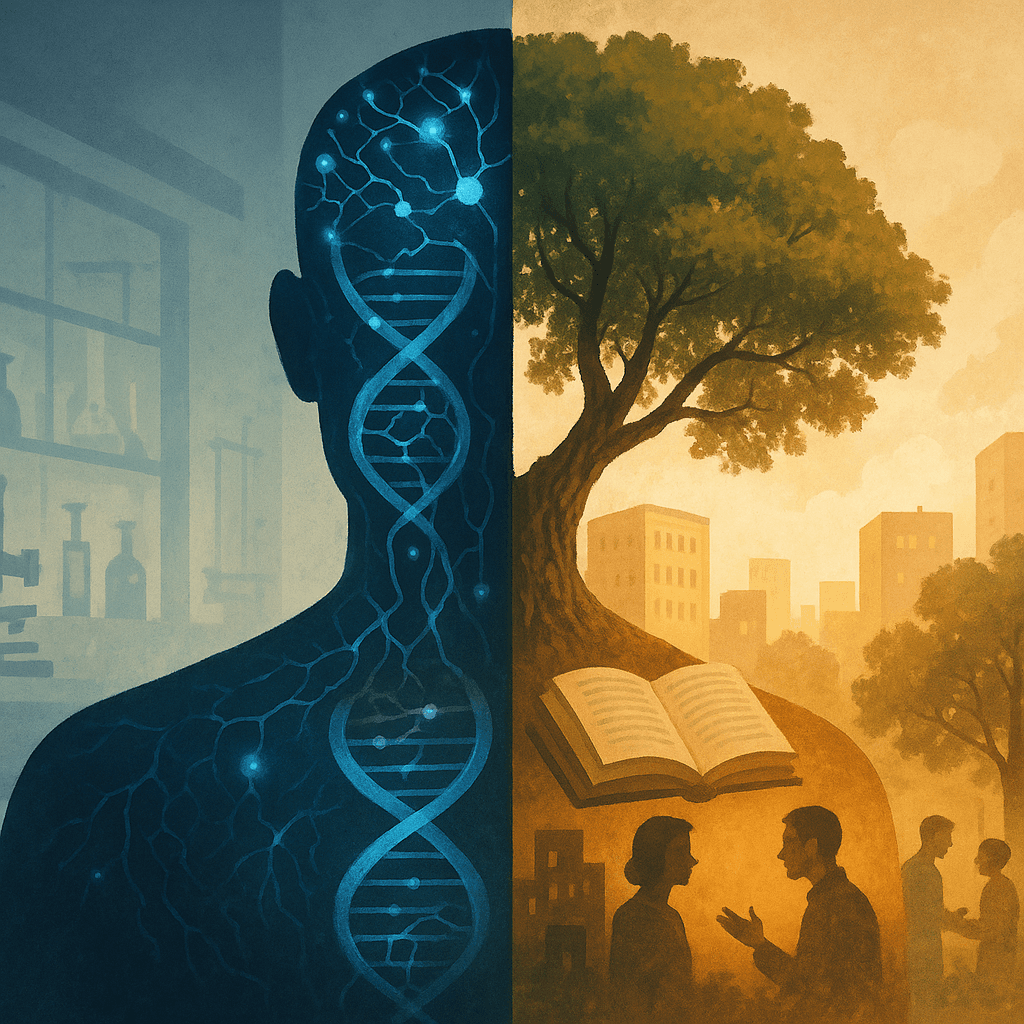
It’s one of those questions that refuses to go away.
Are people born the way they are? Or does life sculpt them, slowly and relentlessly, like water shaping stone?
Some swear they inherited their stubborn streak from their father. Others blame childhood, culture, trauma, success, failure - take your pick. The nature versus nurture debate has been circling psychology for decades like a hawk over an open field.
But here’s the honest answer - it’s complicated. And far more interesting than a simple yes or no.
The Genetic Blueprint - What DNA Really Controls
DNA absolutely plays a role in personality. That part isn’t up for debate anymore.
Studies involving twins - especially identical twins raised apart - show striking similarities in temperament, emotional reactivity, and even certain habits. When two people share the same genetic code and still resemble each other despite growing up in different homes, it’s hard to ignore biology.
Researchers estimate that about 40% to 60% of personality traits are heritable. That’s significant. Not dominant. Not absolute. But substantial.
Think of DNA as the architectural blueprint of a house. It outlines the structure. It suggests how many rooms exist and where the walls stand. But it doesn’t choose the paint color. It doesn’t decide the furniture. It certainly doesn’t predict who will walk through the front door.
Genetics influence traits like:
- Extraversion or introversion
- Emotional sensitivity
- Impulsivity
- Baseline anxiety levels
- Openness to new experiences
Sound familiar? Those align closely with the Big Five personality traits - one of the most validated psychological models in existence.
But DNA sets tendencies, not destinies.
Environment - The Sculptor of Personality
If genes are the blueprint, environment is the construction crew. And sometimes… the weather.
Family dynamics, friendships, education, socioeconomic status, culture, trauma, opportunities - they all leave fingerprints on personality development.
A naturally cautious child raised in a supportive environment might grow into a thoughtful strategist. The same child in a chaotic setting might develop chronic anxiety.
Same wiring. Different outcome.
This is where things get fascinating. Modern psychology doesn’t see personality as fixed. It sees it as dynamic - stable in patterns, yet adaptable over time.
Have you ever noticed how someone becomes more confident after years in a leadership role? Or how a major life event softens a once rigid thinker?
That’s environment reshaping expression.
The Feedback Loop Between DNA and Experience
Here’s a hot take - it’s not genes versus environment. It’s genes interacting with environment.
Psychologists call this gene-environment interaction. A person with a genetic predisposition toward high sensitivity might thrive in nurturing spaces and struggle in harsh ones. Meanwhile, someone genetically wired for resilience may brush off stress that overwhelms others.
DNA loads the gun. Environment pulls - or doesn’t pull - the trigger.
Strong metaphor? Yes. But it captures the interplay.
Can Personality Change Over Time?
Short answer? Yes.
Longer answer? Slowly, intentionally, and often through friction.
Long-term studies show measurable personality shifts across decades. People generally become more conscientious and emotionally stable as they age. Many grow more agreeable. Openness can expand with exposure and learning.
But change rarely happens by accident.
Major catalysts include:
- Career shifts
- Therapy or self-reflection
- Parenthood
- Loss or trauma
- Deliberate skill-building
It’s like steering a large ship. You can adjust direction, but not instantly. Tiny corrections, repeated consistently, alter the course.
So if someone wonders, “Am I just born this way?” the more accurate question might be, “How much of this pattern do I want to keep?”
The Science of Measuring Personality
This is where things get practical.
Understanding whether personality is influenced by DNA becomes less abstract when people actually measure their traits. Modern psychometrics has evolved far beyond simplistic labels.
Platforms like lifematika.com combine eight major psychological models into one streamlined assessment. Instead of boxing users into a single type, it layers multiple scientific perspectives for a fuller picture.
And that matters.
Lifematika integrates:
- OCEAN - The Big Five personality traits
- Jungian typology and cognitive functions
- DISC behavioral styles
- VIA character strengths
- Self-Determination Theory
- Schwartz’s core values framework
- Emotional intelligence metrics
- Motivational drivers
All within 95 questions. About 15 minutes. No registration wall. Immediate results.
Honestly, that level of accessibility changes the self-discovery game.
Because once someone sees their personality broken down into strengths, tendencies, blind spots, and motivations, the DNA debate becomes less philosophical and more actionable.
Why Self-Knowledge Changes the Equation
If personality were entirely genetic and fixed, self-awareness would be pointless.
But research shows the opposite.
When individuals understand their traits, they make better career decisions. They improve communication. They choose environments that complement - rather than fight - their natural wiring.
A highly introverted person might not transform into a charismatic public speaker overnight. But they can build presentation skills while honoring their need for recharge time.
A naturally dominant communicator can learn empathy without losing assertiveness.
Self-awareness acts like a map. It doesn’t move the terrain, but it prevents unnecessary detours.
Common Myths About DNA and Personality
Let’s clear a few things up.
Myth #1: If It’s Genetic, It’s Permanent
Not true. Genetic influence increases probability, not certainty. Height is highly heritable, yet nutrition still matters. Personality works similarly.
Myth #2: Environment Can Override Biology Completely
Also false. You can’t simply train someone out of their neurological wiring. A deeply introverted brain processes stimulation differently. That isn’t a mindset issue - it’s biology.
Myth #3: Personality Tests Box People In
Poorly designed ones might. Scientifically grounded assessments provide nuance. Especially when multiple validated frameworks converge, as they do in comprehensive platforms.
Labels limit. Insight liberates.
So… Is Your Personality Determined by Your DNA?
Here’s the balanced truth.
DNA lays the foundation. Environment builds the structure. Experience renovates the interior. And conscious effort decorates the space.
Personality isn’t a prison sentence written in genetic ink. It’s more like a living document - edited over time, shaped by both biology and choice.
Some traits will feel deeply rooted. Others may surprise you with their flexibility.
The real power lies in understanding the baseline.
Because once someone knows their natural tendencies - through validated models, structured assessments, and reflective analysis - they stop fighting themselves. They start optimizing instead.
And that shift? It changes careers. Relationships. Confidence.
So perhaps the better question isn’t whether personality is determined by DNA.
Maybe it’s this:
Given your wiring, what are you going to build?
That’s where science meets agency. And where self-discovery becomes more than curiosity - it becomes strategy.
Sounds simple.
It isn’t.
But it is worth exploring.