Finding the Best MBTI Test: A 2026 Guide to Personality Assessment Accuracy
 Yaro Pry··4 min read
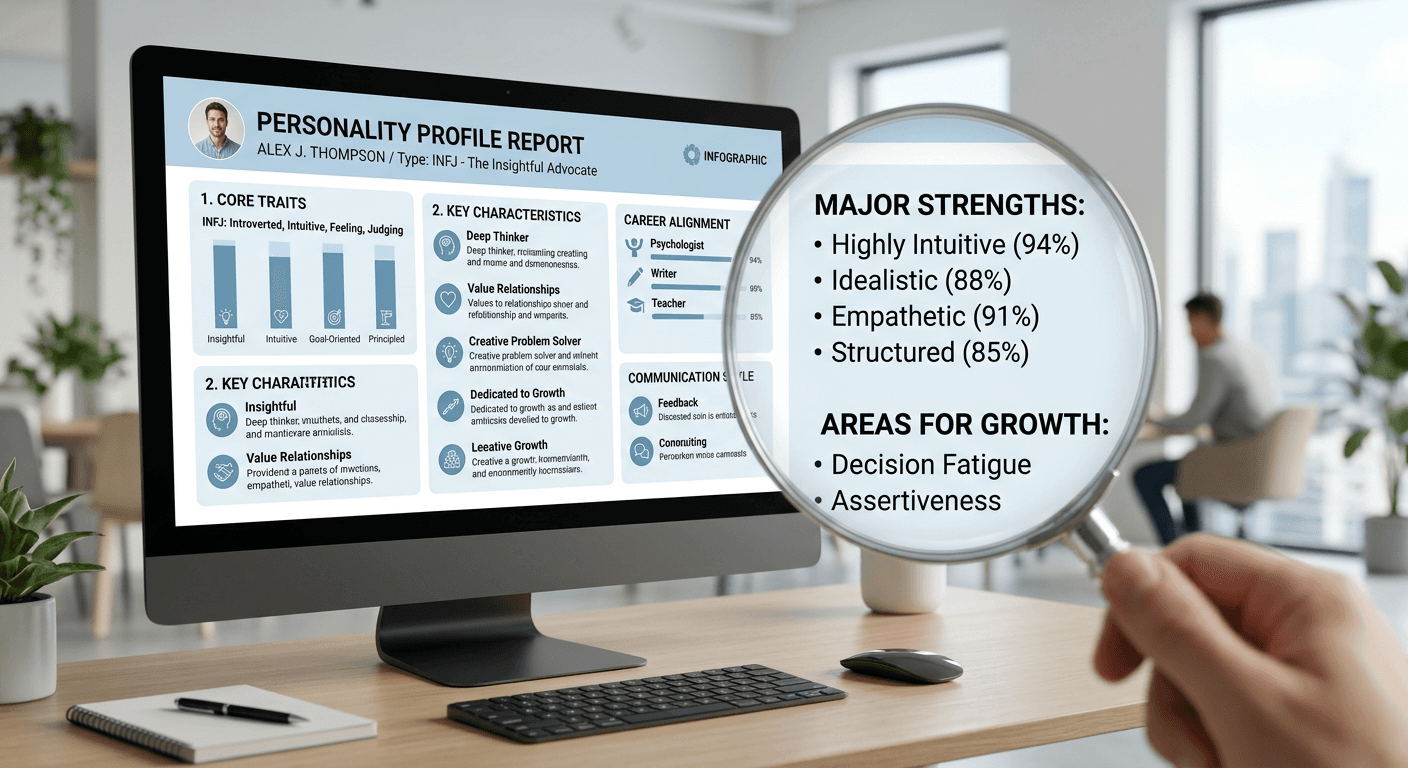
Selecting the best mbti test in 2026 requires moving beyond superficial online quizzes to understand the difference between psychometric rigor and entertainment-based personality inventories. While many platforms offer quick assessments, the utility of your results depends entirely on the validity of the underlying data and the scoring methodology used. When you seek the most accurate mbti test, you are looking for instruments that account for test-retest reliability and provide nuanced feedback rather than just a four-letter label. Understanding how these assessments function can help you navigate the noisy landscape of personality psychology effectively.
Quick Summary
The best mbti test options prioritize psychometric standardization and validated question banks to ensure consistent, actionable personality insights. While many free versions exist online, professional tools often require payment or supervised administration. Reliable assessments offer detailed, evidence-based reports that explain your preferences rather than just categorizing your behaviors.
- Prioritize platforms that provide transparent documentation of their scoring methodology.
- Distinguish between scientific assessments and casual, algorithm-driven web quizzes.
- Look for tests that emphasize longitudinal reliability to ensure your personality type remains consistent.
- Utilize resources like Lifematika to better understand the practical application of personality models.
Table of Contents
- Comparison of Personality Assessment Categories
- The Official MBTI Test and Psychometric Gold Standards
- Independent Psychometric Platforms
- Institutional and Academic Assessment Tools
- Entry-Level Open-Source Alternatives
- Buying Guide - How to Choose a Reliable Assessment
- FAQ
- Recommended Reads

Comparison of Personality Assessment Categories
| Category | Features | Pros | Cons | Target Audience |
|---|---|---|---|---|
| Official MBTI | Standardized, verified, patented | High validity, corporate recognition | Expensive, requires expert login | Enterprises, HR, Leadership |
| Independent Psychometric | High-quality data, detailed reports | Accessible, cost-effective | Variable scientific rigor | Personal growth enthusiasts |
| Open-Source/Academic | Transparent, research-based | Free, open data | Lacks aesthetic interface | Researchers, students |
| Casual/Web Quizzes | Quick, viral-ready | Instant, free | Low accuracy, no reliability | Social media users |
The Official MBTI Test and Psychometric Gold Standards
When professionals discuss the official mbti test, they are referring to the proprietary assessment administered by certified practitioners. This tool is the only version that uses the copyrighted question bank and the refined scoring algorithms developed through decades of psychological research. The primary advantage of the official instrument is its consistency; it is designed to measure preferences against a global norming sample, which makes the mbti test results far more robust for professional development and team building.
Pros
- Highest level of standardization and reliability.
- Accepted by corporate entities for organizational development.
- Access to professional debriefing sessions.
Cons
- High barrier to entry regarding cost and access.
- Not easily available for individual on-demand consumption.
Independent Psychometric Platforms
Independent platforms have filled a critical gap in the market by offering a high-quality mbti test online that maintains a high degree of correlation with the standard model while providing a better user interface. These companies often hire psychologists to audit their question banks, ensuring that the results are not just random outputs. For individuals who want to explore their psychological profile without the corporate overhead of the official version, these platforms are often the best compromise.
Pros
- User-friendly dashboards and interactive data visualization.
- Extensive documentation on how scores are interpreted.
- Significantly more affordable than practitioner-led testing.
Cons
- Lacks the official brand validation for corporate resumes.
- Quality can vary between providers; vetting is required.
Institutional and Academic Assessment Tools
Many universities and research centers provide access to personality inventories that mirror the structure of the MBTI but are built upon open-source datasets. These tools are often the most accurate mbti test alternatives for those who prioritize data transparency over polished marketing. You can often find these through institutional research blogs that focus on behavioral science, where authors explain the nuances of personality trait distribution.
Pros
- Data is typically open-source and peer-reviewed.
- Completely free of commercial influence or upselling.
- Ideal for educational purposes and self-reflection.
Cons
- Lacks the high-end graphic design and user support of commercial tools.
- May require knowledge of psychometric basics to interpret.
Entry-Level Open-Source Alternatives
For those just beginning to look into personality theory, entry-level, non-commercial tools offer a safe starting point. While they may not be the "real mbti test" in terms of proprietary ownership, many of these use validated item pools derived from public domain research. They serve as an excellent educational bridge for anyone who wants to learn the fundamentals of cognitive function theory without committing to a paid assessment.
Pros
- Accessible and instant results.
- Strong focus on educational content and theory.
- No personal data harvesting or hidden subscriptions.
Cons
- Lower test-retest reliability compared to professional instruments.
- Can lead to misinterpretation if not paired with reading material.
Buying Guide - How to Choose a Reliable Assessment
Choosing the right tool depends on your specific objective. If you are using these results for a career change or leadership training, you should prioritize providers that offer a verifiable, certified debriefing process. A high-quality test should always provide a breakdown of confidence intervals in your results rather than presenting a single label as an absolute truth. Before investing money, check if the company provides a sample report; this is the best way to verify if their insights are meaningful or merely generic.
Always verify that the provider explains the methodology. A test that claims to be the most accurate should openly share its internal reliability statistics, such as Cronbach's alpha, to prove that the question bank is consistent. If you are confused by the options, starting a trial assessment can help you gauge the platform's quality before committing to a full psychological profile.
FAQ
- Can an online test really give me a professional diagnosis? No. Personality assessments are tools for self-discovery, not clinical diagnostic instruments. Always interpret your results with nuance.
- Is there a free test that is actually accurate? Many free tests are based on valid theory but lack the extensive norming samples of paid professional tools. Use them for interest, not high-stakes decision-making.
- How often should I retake a personality test? Most experts recommend waiting 6 to 12 months. Personality traits tend to be stable, but your self-perception can change based on life experiences.
- Why do my results change every time I take a test? This often suggests that the test has low test-retest reliability, or that you are answering based on your current mood rather than your long-term preferences.