Choosing the Best DISC Personality Assessment: A Guide to Accurate Profiles in 2026
 Yaro Pry··4 min read
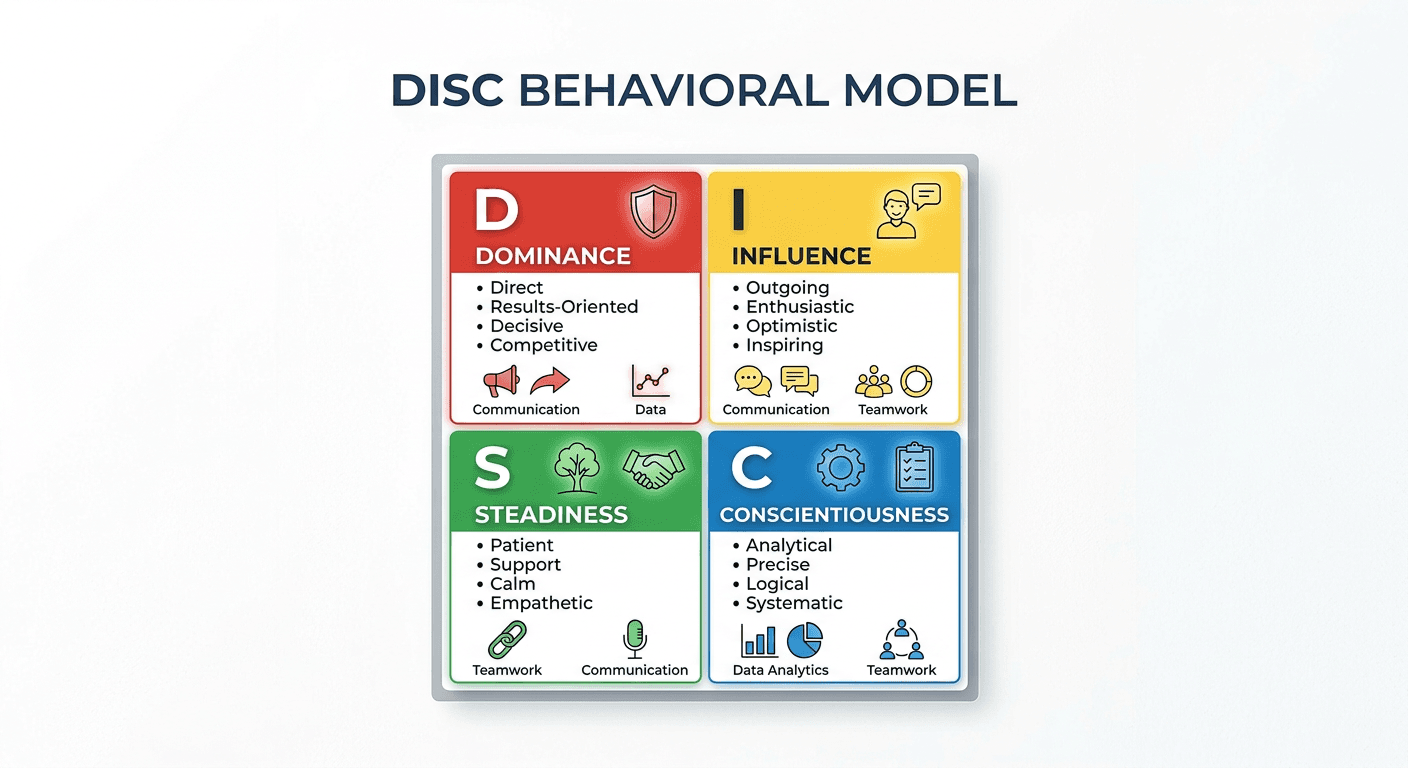
Selecting the right tool to evaluate behavioral traits is a critical step for organizational development and individual growth. A reliable DISC personality assessment acts as a roadmap for understanding human communication styles, conflict resolution tendencies, and workplace motivation. Because not all assessments are built with the same level of scientific rigor, understanding the underlying mechanisms of these tests is essential for both HR professionals and individuals seeking self-awareness. You can learn more about how personality frameworks integrate into wider professional development by checking out resources at Lifematika.
Quick Summary
A DISC personality assessment categorizes behavior into four quadrants: Dominance, Influence, Steadiness, and Conscientiousness. These tools evaluate observable behavioral styles to improve team dynamics, leadership effectiveness, and interpersonal communication. High-quality assessments rely on validated psychometric models rather than anecdotal personality mapping.
- Focus on validated, research-backed assessment providers.
- Understand that DISC measures behavioral style, not cognitive ability.
- Distinguish between comprehensive professional tools and superficial web-based quizzes.
- Use findings to bridge communication gaps in diverse teams.
Table of Contents
- Quick Summary
- Evaluation of Top DISC Assessment Categories
- Professional Psychometric Assessment Platforms
- Integrated HR Management Suite Tools
- Consultant-Led DISC Training Programs
- Public-Domain and Basic Behavioral Screeners
- Understanding DISC Personality Types
- How to Choose the Right Assessment
- FAQ
- Recommended Reads

Evaluation of Top DISC Assessment Categories
| Category | Primary Focus | Best For | Accuracy Level | Cost |
|---|---|---|---|---|
| Professional Psychometric | Data-driven insights | Corporate HR / Leadership | Very High | Premium |
| HR Suite Tools | Scalable recruitment | Talent Acquisition | High | Moderate |
| Consultant-Led | Custom application | Executive Coaching | High | Variable |
| Basic Screeners | General awareness | Individuals / Casual | Low | Free / Low |
Professional Psychometric Assessment Platforms
Professional-grade assessments are the gold standard for organizations. These platforms utilize advanced algorithms that account for social desirability bias, meaning they are designed to detect if a respondent is answering in a way they think the employer wants to see, rather than their true behavioral preference.
Pros
- High reliability and validity scores.
- Extensive documentation on statistical norming.
- Detailed reporting features for team managers.
Cons
- Require higher financial investment.
- Often restricted to business-to-business licensing.
Integrated HR Management Suite Tools
Many modern HR Information Systems (HRIS) have integrated personality profiling as a native feature. These tools are designed to streamline the recruitment process by mapping candidate results directly against role-specific benchmarks. They are highly efficient when managing large-scale hiring initiatives where consistent data collection is paramount. Visit Lifematika to see how streamlined processes can improve overall organizational efficiency.
Pros
- Seamless integration with candidate tracking systems.
- Automated benchmarking for job fit analysis.
- Reduced administrative burden for HR teams.
Cons
- Less customizable than specialized psychometric firms.
- Depth of reporting can be sacrificed for the sake of speed.
Consultant-Led DISC Training Programs
In this model, the assessment is merely the starting point of a larger intervention. Experienced coaches administer the tests and interpret the results through in-person or virtual workshops. This is the most effective approach for leadership development because it forces team members to apply the concepts to real-world friction points immediately.
Pros
- Actionable, context-specific feedback.
- Promotes team bonding and mutual understanding.
- High engagement levels during the interpretation phase.
Cons
- Significant time commitment for the entire team.
- High cost due to expert involvement.
Public-Domain and Basic Behavioral Screeners
There are numerous options available online, often marketed as a free disc personality test or a 123 disc personality test. While these can provide a snapshot of one's communication style, they rarely provide the depth required for professional decision-making. Users should be cautious of sites that lack transparency regarding how their scoring algorithms are derived.
Pros
- Accessible and immediate results.
- Useful for basic self-reflection.
Cons
- Lacks professional validation or peer review.
- Frequently ignores the complexities of the four-quadrant interaction.
- Inconsistent scoring accuracy.
Understanding DISC Personality Types
To effectively interpret what is a disc personality profile, one must look beyond simple labels. The model is built on two primary axes: Task-oriented vs. People-oriented, and Active vs. Passive. Dominance (D) types are task-oriented and active; Influence (I) types are people-oriented and active; Steadiness (S) types are people-oriented and passive; and Conscientiousness (C) types are task-oriented and passive.
Most high-quality tests recognize that human behavior is dynamic. We rarely fall into just one bucket; rather, we exhibit a primary style that surfaces under pressure and a secondary style that we use in more relaxed environments. Exploring Lifematika test methodologies can further clarify how these behavioral styles are measured in controlled settings.
How to Choose the Right Assessment
When evaluating different disc personality test types, prioritize transparency. An assessment provider should clearly state their methodology and provide access to technical manuals or white papers. If an assessment claims to reveal deep psychological truths without explaining the data behind its claims, it is likely a marketing tool rather than a scientific instrument.
Consider the intended outcome. If you are conducting a hiring process, you need a tool that complies with legal standards for employment testing. If you are fostering team communication, you need a tool with high face validity that team members can easily understand and discuss without needing a degree in psychology. Avoid over-reliance on free online calculators that do not offer ongoing support or integration into your organizational culture.
FAQ
- Is a free DISC personality test as accurate as a paid one? No. Paid assessments invest heavily in psychometric validation and bias reduction, while free versions are often simplistic, generic interpretations of the DISC model.
- Can a DISC profile predict job success? It can predict behavioral fit for specific roles, but it should never be used as the sole criteria for hiring. It measures style, not skill, intelligence, or experience.
- How often should one take a DISC assessment? Once every 12 to 24 months is standard for professional development, as behavioral styles are relatively stable but can evolve with significant life or career transitions.