Why the Big Five is the Gold Standard of Personality Science
 Yaro Pry··5 min read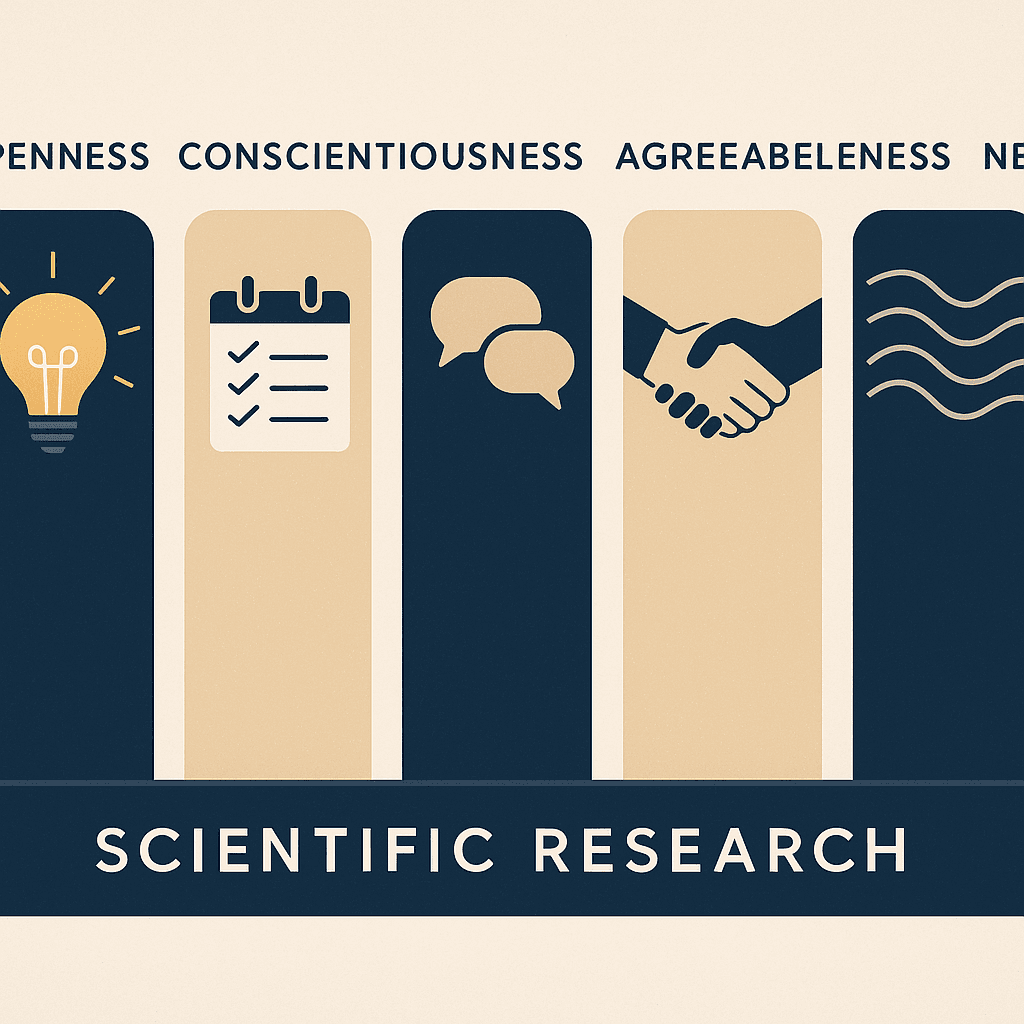
Personality tests are everywhere. Scroll through social media and someone is announcing they’re an ENFP. Open a business magazine and you’ll see DISC charts floating around like corporate horoscopes. It’s noisy. Confusing. Sometimes a little gimmicky. But when psychologists sit down at the serious table - the one with peer-reviewed journals and decades of data - one model keeps showing up. The Big Five. Also known as OCEAN. And if you ask most researchers quietly, off the record, they’ll tell you the same thing: it’s the gold standard of personality science. Why? Let’s unpack it.
What Is the Big Five Personality Model?
At its core, the Big Five personality model breaks human personality into five broad dimensions:
- O - Openness to Experience
- C - Conscientiousness
- E - Extraversion
- A - Agreeableness
- N - Neuroticism
Simple list. Massive implications. Instead of stuffing people into rigid "types," the Big Five measures traits on a spectrum. Think dimmer switch, not light switch. No one is just "organized" or "not organized." They fall somewhere along a gradient of conscientiousness. That nuance? That’s where the science lives.
Why Researchers Trust the Big Five
Here’s the hot take - popularity doesn’t equal validity. A personality framework can trend on TikTok and still crumble under statistical scrutiny. The Big Five doesn’t crumble.
1. It’s Built From Data, Not Theory Alone
Many personality systems start with a compelling idea. Then they look for evidence. The Big Five flipped that script. Researchers analyzed thousands of personality-describing words across languages. They used factor analysis - a statistical method that groups related traits together - and the same five clusters kept appearing. Across cultures. Across decades. That’s not coincidence. That’s structure.
2. It Predicts Real-Life Outcomes
Here’s where it gets practical. The Big Five isn’t just academic wallpaper. It predicts:
- Job performance
- Relationship satisfaction
- Leadership effectiveness
- Stress resilience
- Even longevity
Conscientious individuals, for example, consistently perform better at work. Higher neuroticism often correlates with greater emotional volatility. Strong agreeableness supports smoother collaboration. It’s not fortune-telling. It’s probability. And probability is powerful.
3. It Works Across Cultures
Some personality frameworks wobble when tested globally. The Big Five? It holds up. Researchers have replicated its structure in dozens of countries. Different languages. Different traditions. Same five dimensions emerging like bedrock beneath shifting sand. That kind of cross-cultural reliability is rare. And valuable.
The Spectrum Advantage - Why Traits Beat Types
Type-based systems feel satisfying. Humans like boxes. They’re tidy. But life isn’t tidy. Imagine describing height using only "short" and "tall." Absurd, right? We understand instinctively that height exists on a continuum. Personality works the same way. The Big Five captures degrees of difference. Someone can be moderately extraverted and highly agreeable but low in openness. That combination tells a richer story than a four-letter code ever could. Nuance is the difference between a sketch and a portrait.
How the Big Five Compares to Other Personality Models
Let’s be fair. Other systems offer value. Jungian typology provides insight into cognitive preferences. DISC clarifies communication styles. Character strengths frameworks highlight virtues. But the Big Five stands out because:
- It’s empirically grounded
- It’s statistically stable
- It integrates well with neuroscience research
- It predicts measurable outcomes
It doesn’t compete with other models so much as anchor them. In fact, modern psychometric platforms like lifematika.com incorporate the Big Five alongside seven additional validated methodologies. That layered approach reflects something important - personality is complex. No single lens captures everything. But if there’s a backbone holding the system upright, it’s OCEAN.
Breaking Down the Five Traits - In Real Life
Let’s move from theory to reality.
Openness to Experience
High openness looks like curiosity, creativity, comfort with abstraction. These individuals enjoy new ideas and unconventional paths. Lower openness? More traditional, practical, grounded in routine. Neither is better. Context decides what works.
Conscientiousness
This is the productivity engine. Organized. Reliable. Goal-focused. High scorers often excel in structured environments. Lower scorers may prefer flexibility and spontaneity. If life were a train system, conscientiousness determines whether the trains run on schedule.
Extraversion
Energy direction. That’s the key. Extraverts recharge through social interaction. Introverts recharge in solitude. Most people fall somewhere between the extremes. The Big Five doesn’t label introversion as a flaw - it simply maps where energy flows.
Agreeableness
Compassion. Cooperation. Trust. High agreeableness fosters harmony. Lower agreeableness can correlate with competitiveness or directness. Too much of either, in the wrong environment, creates friction. Balance matters.
Neuroticism
Perhaps the most misunderstood trait. It measures emotional sensitivity and stress reactivity. Higher levels can mean heightened vigilance and depth of feeling. Lower levels often bring emotional stability. Again - spectrum, not judgment.
Why the Big Five Matters for Self-Discovery
Here’s the thing. Self-awareness isn’t just philosophical fluff. It drives decisions. Career paths. Relationships. Communication style. Stress management. When individuals understand where they fall within the Big Five dimensions, they stop fighting their wiring. Instead of asking, "Why am I like this?" they begin asking, "How can I work with this?" That shift is subtle. But it changes everything. Modern tools have made this exploration faster and more accessible. Platforms like lifematika.com offer a 95-question assessment that takes roughly 15 minutes and generates an instant, detailed report. No registration walls. No endless forms. Just structured insight grounded in eight established psychological models, including the Big Five. And because personality evolves with experience, the ability to retake assessments after major life changes adds a longitudinal layer most casual quizzes never consider. Self-knowledge shouldn’t be static.
The Scientific Backbone - Why "Gold Standard" Isn’t Hype
Calling something the gold standard implies comparison. In medicine, it means the most validated treatment. In measurement science, it means the most reliable instrument. For personality research, the Big Five earns that title because it checks the essential boxes:
- Reliability - results remain stable over time
- Validity - it measures what it claims to measure
- Replicability - findings repeat across samples
- Predictive power - it connects to real-world outcomes
Few models achieve all four consistently. The Big Five does.
Common Misconceptions About the Big Five
Let’s clear the air. Myth 1: It puts people in boxes.
False. It measures degrees, not categories. Myth 2: It’s too broad to be useful.
Broad traits create stable foundations. Specific behaviors can then be mapped onto them. Myth 3: Personality never changes.
Research shows gradual shifts across the lifespan. Conscientiousness often increases with age. Neuroticism can decline. The model tracks change - it doesn’t freeze identity.
Why It’s Still Relevant Today
In a world obsessed with quick labels and viral personality memes, the Big Five feels almost… grounded. It doesn’t promise destiny. It doesn’t reduce identity to a slogan. It provides measurable dimensions backed by decades of empirical work. That’s less flashy. But it’s enduring. And when people want clarity rather than entertainment, they tend to circle back to what’s stable. The Big Five remains that stable core.
Final Thought - Science Over Hype
Personality science isn’t about telling someone who they are. It’s about offering a mirror polished by research instead of opinion. The Big Five stands tall because it was carved from data, refined by replication, and stress-tested across cultures. Other models add color and context. They’re valuable. Useful. Yet when psychologists need a reliable framework - the one that holds under pressure - they return to OCEAN. Five dimensions. Infinite combinations. Simple structure. Complex humanity. And that balance, honestly, is why the Big Five continues to earn its reputation as the gold standard of personality science.