Understanding Schwartz’s Theory of Basic Human Values
 Yaro Pry··4 min read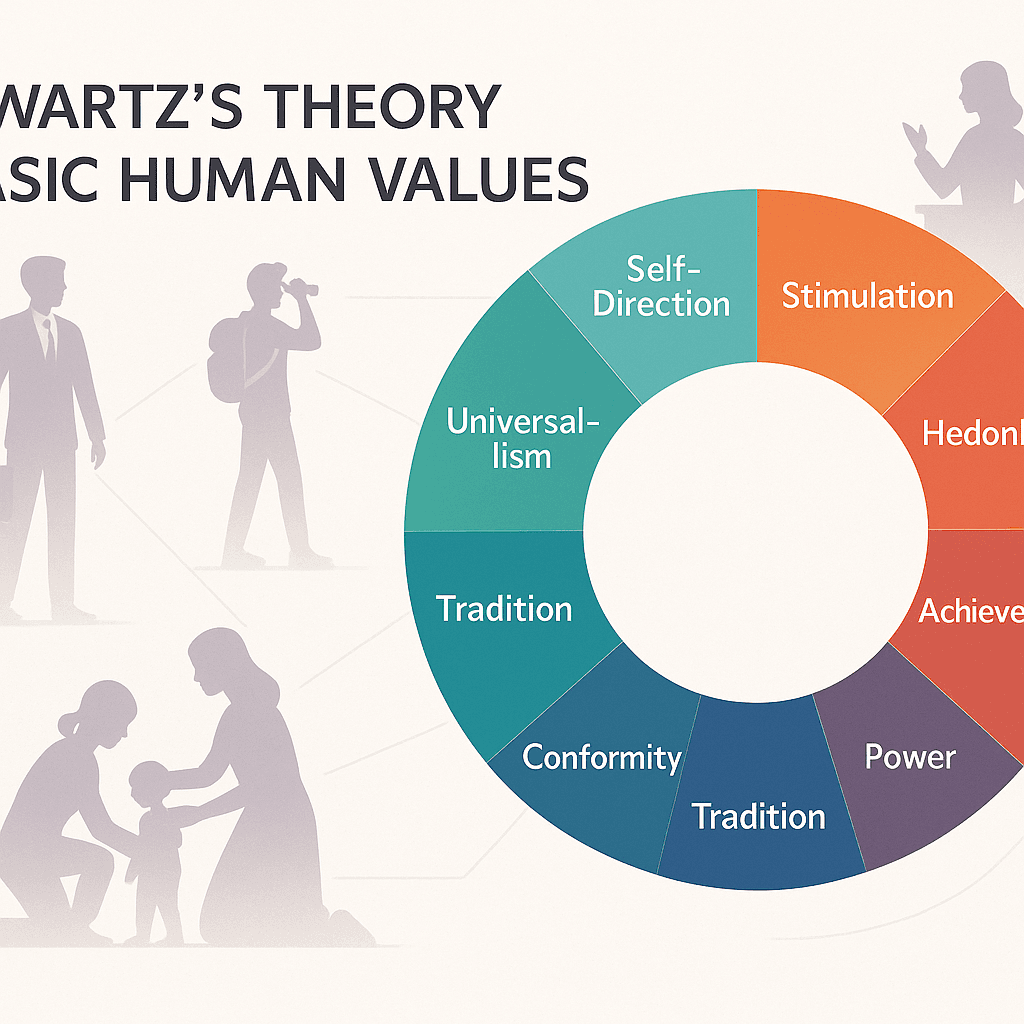
Why do people choose wildly different paths, even when they start from the same place? Why does one person chase adventure across continents while another builds a quiet, stable life close to home? It is tempting to say “personality.” But that’s only half the story. Beneath personality traits sits something deeper - something steadier. Values.
Schwartz’s Theory of Basic Human Values digs into that deeper layer. And honestly, it explains more about human behavior than most people realize.
What Is Schwartz’s Theory of Basic Human Values?
Developed by social psychologist Shalom Schwartz, the theory identifies a set of universal human values shared across cultures. Not hobbies. Not preferences. Values - the core principles that quietly guide decisions, priorities, and behavior.
Think of values as an internal compass. You don’t always stare at it, but it constantly influences your direction.
Schwartz discovered that across countries, religions, and economic systems, people tend to organize their motivations around ten core value types. These values form a circular structure, meaning some complement each other while others naturally conflict.
Sounds abstract? Stay with it. It gets practical fast.
The 10 Core Human Values
Schwartz grouped values into ten broad categories:
- Self-Direction - independence, creativity, freedom of thought
- Stimulation - excitement, novelty, challenge
- Hedonism - pleasure, enjoyment of life
- Achievement - success, competence, personal accomplishment
- Power - status, control, authority
- Security - safety, stability, order
- Conformity - restraint, respect for rules and norms
- Tradition - cultural or religious customs
- Benevolence - loyalty, care for close others
- Universalism - equality, environmental protection, social justice
Notice something interesting? Some of these values sit comfortably together. Others clash.
For example:
- Self-Direction often conflicts with Conformity.
- Power may sit uncomfortably beside Universalism.
- Stimulation can disrupt Security.
It’s like trying to press the gas pedal and the brake at the same time. Something has to give.
The Circular Structure - Why It Matters
Here’s where Schwartz’s framework becomes more than a list. The values form a circle based on motivational compatibility.
Adjacent values support each other. Opposing ones create tension.
This circular model explains internal conflict better than most personality systems ever could.
Imagine someone who deeply values Achievement but also prioritizes Benevolence. When work demands 80-hour weeks, tension appears. Should they chase success or protect family time? The stress isn’t random - it’s value conflict in action.
Once someone sees that pattern, decisions start to feel less chaotic and more intentional.
Four Higher-Order Value Groups
Schwartz further organized the ten values into four broader categories:
1. Openness to Change
- Self-Direction
- Stimulation
- Hedonism
These emphasize independence and novelty.
2. Conservation
- Security
- Conformity
- Tradition
These prioritize stability and order.
3. Self-Enhancement
- Achievement
- Power
These focus on personal success and dominance.
4. Self-Transcendence
- Benevolence
- Universalism
These highlight concern for others and the wider world.
Look at that layout for a moment. It almost reads like a map of modern society’s biggest debates. Individual freedom vs. tradition. Competition vs. compassion. Stability vs. exploration.
These aren’t random cultural arguments. They reflect competing value systems.
Why Understanding Human Values Changes Everything
Here’s the part people underestimate: values drive long-term satisfaction more than goals do.
Goals are destinations. Values are the engine.
If someone sets a goal that contradicts their core principles, motivation fades. Burnout creeps in. Resentment builds quietly.
But when actions align with values? Energy feels sustainable. Decisions feel cleaner.
Have you ever noticed how some choices feel “right” even if they’re difficult? That’s value alignment at work.
Values vs. Personality - Not the Same Thing
Many people confuse personality traits with values. They overlap, yes. But they aren’t identical.
Personality describes how someone tends to behave.
Values explain why.
For instance, an introverted person might value Universalism and quietly advocate for environmental causes. Another introvert might prioritize Security and focus on building financial stability.
Same trait. Different motivations.
This distinction matters when making career decisions, choosing relationships, or navigating conflict.
How Schwartz’s Theory Applies to Real Life
This isn’t just academic theory buried in psychology journals. It has practical implications across multiple areas:
Career Choices
- High Achievement and Power values may thrive in competitive environments.
- Strong Universalism might lead toward nonprofit or advocacy work.
- Security-oriented individuals often prefer structured, predictable roles.
Relationships
Value compatibility often predicts long-term harmony better than shared hobbies.
If one partner values Stimulation while the other prioritizes Tradition, friction can appear. Neither is wrong. They’re simply wired toward different motivational poles.
Leadership and Workplace Culture
Organizations carry collective value profiles. A startup driven by Openness to Change feels radically different from a corporation anchored in Conservation.
Employees who align with company values tend to stay longer and perform better. It’s not magic. It’s alignment.
Measuring Personal Values - A Scientific Approach
Understanding values conceptually is helpful. Measuring them accurately? That’s transformative.
Platforms like lifematika.com integrate Schwartz’s Theory of Basic Human Values into a broader psychometric framework. The platform combines eight established psychological models into one streamlined assessment.
Here’s what makes it compelling:
- 95 research-based questions
- Approximately 15 minutes to complete
- Free to start, no registration required
- Instant, detailed analytical report
- Full confidentiality and data protection
- Ability to retake and track personal changes over time
Rather than isolating values, the system analyzes them alongside personality traits, motivational drivers, emotional intelligence, and behavioral styles.
It’s like switching from a flashlight to stadium lighting. Suddenly patterns become visible.
Common Misunderstandings About Human Values
Let’s clear up a few myths.
“Some values are better than others.”
Not true. Values are not moral rankings. They reflect priorities, not virtue levels.
“Values never change.”
They are relatively stable, but life events - parenthood, career shifts, crises - can adjust emphasis. That’s why reassessment matters.
“Conflict means incompatibility.”
Actually, internal value tension can fuel growth. Balancing Achievement and Benevolence, for example, can lead to responsible leadership.
Why Values Matter More Than Ever
Modern life offers endless choice. Career pivots. Remote work. Global mobility. Digital identities.
Choice is liberating. It’s also overwhelming.
Without clarity about core motivations, people drift. They chase trends. They mirror others. They wake up wondering why success feels hollow.
Understanding Schwartz’s Theory of Basic Human Values provides a stabilizing anchor. It helps individuals filter opportunities through something deeper than impulse.
Ask this: Does this decision support Openness to Change? Does it strengthen Security? Does it advance Universalism?
When answers align, confidence follows.
The Bigger Picture
Schwartz’s model doesn’t box people in. It doesn’t label them permanently. Instead, it reveals motivational architecture - the invisible blueprint shaping behavior.
And once someone sees that blueprint, self-awareness expands.
Decisions feel less reactive. Goals feel more authentic. Conflicts make more sense.
Values aren’t loud. They don’t shout for attention. They hum quietly in the background, guiding choices day after day.
Understanding them isn’t just interesting psychology trivia. It’s strategic self-knowledge.
And in a world pulling attention in every direction, that kind of clarity? It’s powerful.