The Thinking vs. Feeling Struggle in Modern Careers
 Yaro Pry··4 min read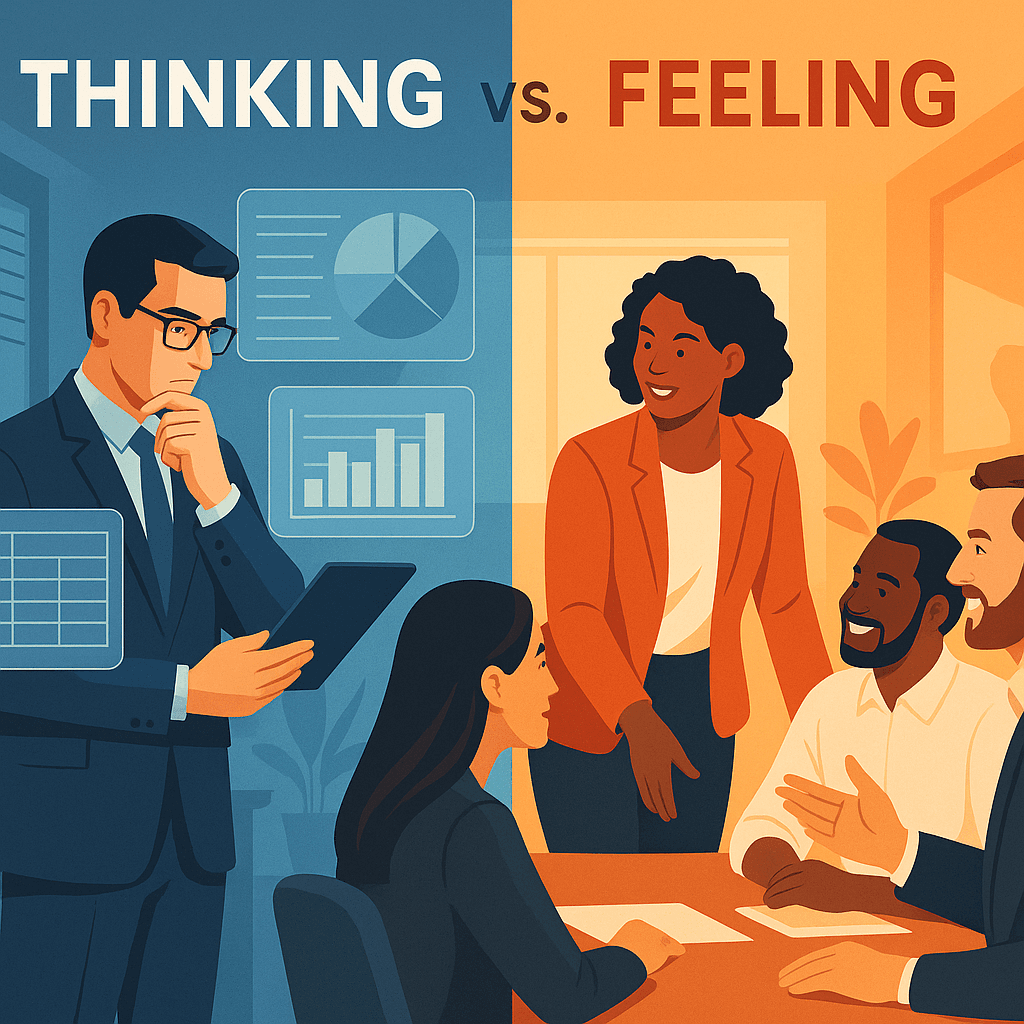
There is a quiet tug-of-war happening in offices, startups, Zoom calls, and late-night Slack threads across the world. It is not about salaries. Not about job titles. Not even about remote versus hybrid.
It is the Thinking vs. Feeling struggle in modern careers.
Logic against empathy. Data against intuition. Spreadsheets versus gut instinct. And here is the thing - both sides believe they are right.
If you ask seasoned managers, they will often say decisions must be rational. Numbers do not lie. Metrics keep businesses alive. Sounds sensible, right?
But walk into any team conflict, burnout situation, or leadership breakdown, and suddenly emotions are steering the ship whether anyone admits it or not.
So what is really happening here?
Understanding Thinking vs. Feeling in Career Decisions
In personality psychology, Thinking and Feeling are not about intelligence versus emotion. That is a common misconception. They are decision-making styles.
- Thinking types prioritize logic, structure, and objective analysis.
- Feeling types prioritize values, relationships, and emotional impact.
Neither approach is superior. They simply operate on different internal compasses.
Picture two executives reviewing the same proposal. One asks, "Does this increase efficiency and profit margin?" The other asks, "How will this affect team morale and long-term trust?"
Both questions matter. The tension appears when one question silences the other.
Why Modern Workplaces Amplify the Conflict
Work today moves fast. Faster than it did a decade ago. Decisions are compressed into short meetings and quick messages. That speed tends to reward analytical clarity over emotional nuance.
Metrics dominate dashboards. Performance indicators glow on screens like scoreboards at a championship game. Win or lose.
But humans are not spreadsheets.
Here is a hot take - companies often claim to value emotional intelligence, yet promotions frequently go to those who appear decisive and detached. It is easier to measure revenue growth than psychological safety.
And yet, research keeps showing the same pattern: teams with high emotional intelligence outperform those driven purely by cold efficiency.
So why does the struggle persist?
The Rise of Data-Driven Culture
Analytics tools have transformed decision-making. Leaders can now track behavior, productivity, engagement, even sentiment. The availability of data creates an illusion of certainty.
If the numbers say yes, move forward.
But data rarely captures the full human story. It shows what happened. Not always why.
The Emotional Burnout Epidemic
Burnout is not caused solely by workload. Often, it grows from value misalignment. Employees who feel unheard or emotionally disconnected begin to disengage.
And disengagement spreads quietly. Like a slow leak in a tire - invisible at first, catastrophic later.
How Personality Shapes Career Paths
The Thinking vs. Feeling dynamic is deeply rooted in personality structure. It is not a switch someone flips depending on mood. It is wired preference.
This is where platforms like lifematika.com become incredibly relevant. Instead of forcing people into vague categories, Lifematika integrates eight established psychological models into a single 95-question assessment that takes about 15 minutes.
No registration. Instant report. Science-backed analysis.
And what makes it interesting is the holistic approach:
- OCEAN - measuring the Big Five traits.
- Jungian typology - including the Thinking vs. Feeling dimension.
- DISC - mapping communication style.
- VIA character strengths.
- Self-Determination Theory - intrinsic motivation.
- Schwartz values framework.
- Emotional intelligence metrics.
- Motivational levels analysis.
That combination provides context. Because no one is purely analytical or purely empathetic. Personalities are layered, like geological strata formed over years of experience.
When Thinking Dominates Too Much
There are undeniable advantages to analytical leadership:
- Clear decision frameworks
- Consistency under pressure
- Objective conflict resolution
- Strategic long-term planning
But overreliance on logic can create blind spots.
Employees may feel reduced to output units. Feedback becomes transactional. Culture turns sterile.
And here is the subtle danger - leaders who suppress emotional considerations often underestimate how much emotions influence their own decisions. No one is purely rational. Neuroscience settled that debate long ago.
When Feeling Takes Over
On the flip side, empathy-driven leadership fosters loyalty and psychological safety. Teams feel seen. Heard. Valued.
Yet emotional decision-making without structure can create inconsistency.
- Difficult conversations get postponed.
- Poor performance lingers unaddressed.
- Short-term harmony overrides long-term sustainability.
Balance matters. Always.
The Career Crossroads - Choosing Head or Heart
Consider common professional dilemmas:
- Accept a higher-paying role that feels misaligned?
- Stay loyal to a team despite limited growth?
- Prioritize stability over passion?
These are not spreadsheet questions. They are identity questions.
Thinking-dominant individuals may evaluate risk, market trends, compensation trajectories. Feeling-oriented individuals may focus on meaning, impact, and interpersonal dynamics.
Who is right?
Both - depending on context.
The real power emerges when individuals understand their natural bias. Self-awareness transforms conflict into calibration.
Why Self-Knowledge Is the Competitive Advantage
Modern careers are no longer linear ladders. They resemble climbing walls - sideways moves, diagonal shifts, unexpected holds. Without understanding one’s internal drivers, it is easy to grab the wrong grip.
A scientific assessment can clarify:
- Core strengths
- Motivational patterns
- Decision-making tendencies
- Emotional intelligence capacity
- Value alignment
Lifematika stands out because it merges multiple validated frameworks into one coherent report. Users can retake the assessment after major life events or career transitions, tracking psychological shifts over time.
That adaptability matters. People evolve. Context changes. So should self-understanding.
Bridging the Gap in Teams
The Thinking vs. Feeling divide does not need to be a battlefield. It can become a complementary system.
Here are practical strategies organizations can apply:
1. Normalize Decision Transparency
Encourage leaders to explain both the logical reasoning and the human considerations behind choices.
2. Pair Complementary Styles
Strategic thinkers working alongside empathetic communicators create balanced outcomes.
3. Train Emotional Intelligence
Emotional skills are not fixed traits. They can be developed with intention.
4. Use Psychometric Insights Responsibly
Tools grounded in research help teams understand differences without stereotyping.
When personalities are mapped thoughtfully, friction transforms into productive dialogue instead of silent resentment.
The Future of Work - Integration, Not Opposition
The modern workforce is shifting toward integration. Artificial intelligence handles data-heavy analysis. That leaves uniquely human capacities - empathy, creativity, moral reasoning - as premium assets.
Ironically, the more automated workplaces become, the more emotional intelligence rises in value.
Thinking without Feeling becomes mechanical.
Feeling without Thinking becomes chaotic.
Together? Strategic empathy. Rational compassion. Sustainable leadership.
The struggle will not disappear entirely. Nor should it. Tension generates growth. But unmanaged tension creates fracture lines.
Professionals who understand where they lean on the Thinking vs. Feeling spectrum gain leverage. They can stretch deliberately. Adapt consciously. Lead intentionally.
And perhaps that is the real evolution of modern careers - not choosing between head and heart, but learning how to let them collaborate.
Because at the end of the day, businesses are built by humans. Complex, emotional, analytical humans.
Ignoring either side is like trying to row a boat with one oar. You will move, sure. Just in circles.