The Relationship Between Big Five Traits and Job Performance
 Yaro Pry··5 min read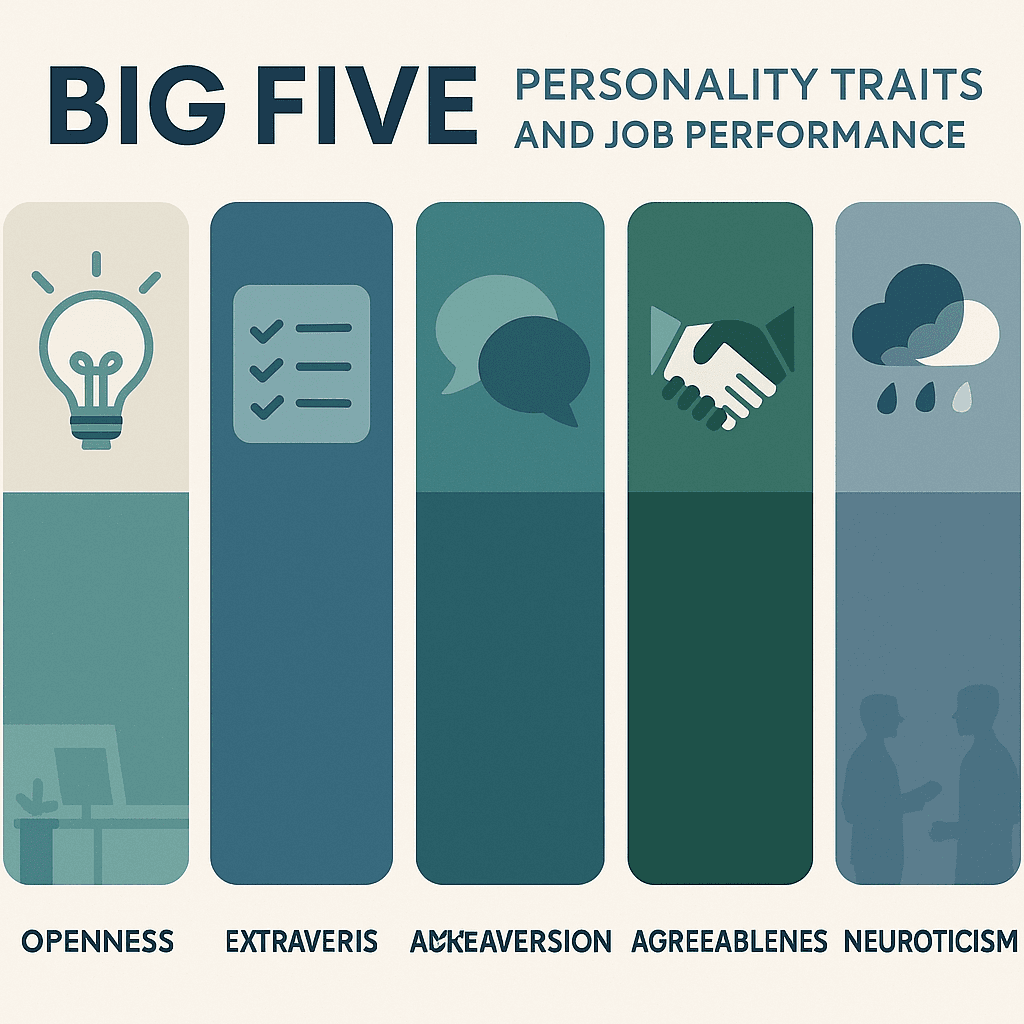
Why do some people thrive at work while others quietly stall out - even when their résumés look identical? It is tempting to blame luck, timing, or that one difficult manager. But psychology offers a sharper lens. The Big Five personality traits, often called the OCEAN model, provide one of the most reliable frameworks for understanding job performance.
Here’s the thing. Skills get someone hired. Personality often determines whether they excel, plateau, or burn out.
And if that sounds dramatic, it’s because it kind of is.
What Are the Big Five Personality Traits?
The Big Five traits represent five broad dimensions of human personality. Think of them as five sliders on a control panel - each person has a unique setting.
- Openness to Experience - creativity, curiosity, willingness to try new ideas
- Conscientiousness - organization, discipline, reliability
- Extraversion - sociability, assertiveness, energy
- Agreeableness - empathy, cooperation, trust
- Neuroticism - emotional reactivity, stress sensitivity
Simple labels. Complex consequences.
Researchers have studied these traits for decades across industries, cultures, and job levels. The verdict? Personality and job performance are tightly connected - though not always in obvious ways.
Why Personality Matters More Than People Think
Imagine two employees with identical technical ability. Same education. Same certifications. Same tools.
One meets deadlines religiously, handles feedback calmly, and adapts when projects shift direction. The other procrastinates, takes criticism personally, and struggles when routines change.
What separates them? Not intelligence. Not opportunity.
Personality traits.
Work is not just about tasks. It is about behavior patterns repeated daily. Over months. Over years. Personality quietly shapes those patterns like gravity shapes the orbit of a planet.
Conscientiousness - The Heavyweight Champion of Job Performance
If there were a gold medal for predicting workplace success, conscientiousness would win. Repeatedly.
This trait consistently shows the strongest correlation with overall job performance across roles. Why?
Highly conscientious employees tend to:
- Meet deadlines consistently
- Follow through on commitments
- Plan before acting
- Pay attention to detail
- Persist when tasks get difficult
In practical terms, they are dependable. Managers trust them. Teams rely on them.
Here’s a hot take - talent without discipline rarely scales. Conscientiousness acts like compound interest. Small, consistent behaviors accumulate into long term results.
Does that mean low conscientiousness equals failure? Not necessarily. But it often requires stronger systems and external structure to compensate.
Openness to Experience - The Innovation Driver
Openness plays a different role. It does not always predict performance in routine jobs. However, in creative, strategic, or rapidly changing fields, it becomes incredibly valuable.
Employees high in openness typically:
- Generate novel ideas
- Embrace change
- Learn new systems quickly
- Challenge outdated assumptions
Think about industries like technology, marketing, design, research. Innovation is oxygen there. Without it, organizations suffocate.
Yet, extreme openness without execution can feel like a brainstorming session that never ends. Ideas need structure. Vision needs delivery.
Balance matters.
Extraversion - Fuel for Leadership and Sales
Extraversion often shines in roles involving social interaction. Sales. Leadership. Public relations. Client management.
Why? Energy is contagious. Assertiveness helps close deals. Comfort with visibility makes presentations smoother.
But here is something people overlook. Introverts can perform exceptionally well too - especially in analytical or independent roles. Extraversion is not a universal advantage. It is context dependent.
In leadership research, moderate to high extraversion correlates with perceived effectiveness. Employees often interpret visible confidence as competence. Fair or not, perception influences opportunity.
Have you ever noticed how some people seem to "own" a room the moment they enter? That is extraversion at work.
Agreeableness - The Glue of Team Performance
Agreeableness rarely headlines performance discussions. It should.
Teams crumble without cooperation. Conflict drains energy. Distrust slows progress.
High agreeableness contributes to:
- Stronger collaboration
- Better conflict resolution
- Supportive work environments
- Higher team morale
However, extreme agreeableness can reduce assertiveness. Saying yes to everything. Avoiding necessary confrontation. Overcommitting.
Like salt in cooking, the right amount enhances everything. Too much changes the flavor.
Neuroticism - The Stress Amplifier
Neuroticism, sometimes reframed as emotional instability, often shows a negative relationship with job performance - especially in high pressure roles.
Individuals high in neuroticism may:
- Experience anxiety under deadlines
- React strongly to criticism
- Struggle with uncertainty
- Burn out faster
That said, a moderate level of emotional sensitivity can increase vigilance. It can motivate preparation. It can heighten awareness of risk.
Again - balance.
The Interaction Effect - Why No Trait Works Alone
Here is where things get interesting.
Traits do not operate in isolation. A highly open and highly conscientious person might innovate and execute. A highly extraverted but low agreeable leader may drive results but create friction.
Job performance emerges from combinations, not single dimensions.
That complexity explains why simplistic personality labels fall short. Real insight requires deeper analysis.
Measuring the Big Five Accurately
Plenty of online quizzes claim to measure personality. Many are entertaining. Few are rigorous.
For those serious about understanding the relationship between Big Five traits and job performance, scientifically grounded assessments matter. Platforms like lifematika.com provide a comprehensive psychometric evaluation built on eight validated psychological methodologies - including the OCEAN model.
The assessment takes about 15 minutes and includes 95 carefully designed questions. No registration. Free to start. Immediate detailed report.
What makes it compelling is the integration. Instead of isolating Big Five traits, it combines:
- Jungian typology
- DISC behavioral mapping
- VIA character strengths
- Emotional intelligence metrics
- Motivational drivers
- Core value frameworks
That holistic perspective paints a fuller picture of workplace potential. Strengths. Blind spots. Growth areas.
And because users can retake the assessment, they can track personality shifts after promotions, career changes, or major life events. Personality is relatively stable - but behavior evolves.
Applying Big Five Insights to Career Growth
Understanding personality is not about labeling. It is about leverage.
Practical ways professionals use Big Five insights:
- Choosing roles aligned with natural strengths
- Designing productivity systems that match trait patterns
- Improving communication with colleagues
- Developing emotional regulation strategies
- Preparing for leadership responsibilities
For example, someone lower in conscientiousness might rely on structured project management tools. A highly neurotic employee might prioritize stress management routines. An introverted strategist could schedule recovery time after intense meetings.
Self awareness becomes a performance multiplier.
What Employers Should Pay Attention To
Organizations increasingly incorporate personality assessment into hiring and development processes. When used ethically and scientifically, it reduces guesswork.
However, here’s the caution. No single trait guarantees success. Context matters. Culture matters. Role demands matter.
The smarter approach? Align personality patterns with job requirements rather than chasing a mythical "ideal" profile.
A startup scaling rapidly might prioritize openness and resilience. A compliance heavy industry may emphasize conscientiousness and emotional stability. Different environments reward different configurations.
The Bigger Picture
Personality influences job performance the way climate influences agriculture. It does not dictate every outcome. But it sets conditions.
Ignore it, and you operate blindly.
Understand it, and you make decisions with sharper precision - career choices, hiring strategies, leadership development plans.
The Big Five framework remains one of the most validated models in psychology for a reason. It balances simplicity with predictive power. It respects nuance. It evolves with research.
So the real question becomes this: if personality shapes daily behavior, and daily behavior shapes career trajectory, why leave it unexplored?
Clarity changes everything.