The ENTJ Meaning Unpacked: Cognitive Mechanics, Testing, and Compatibility
 Yaro Pry··6 min read
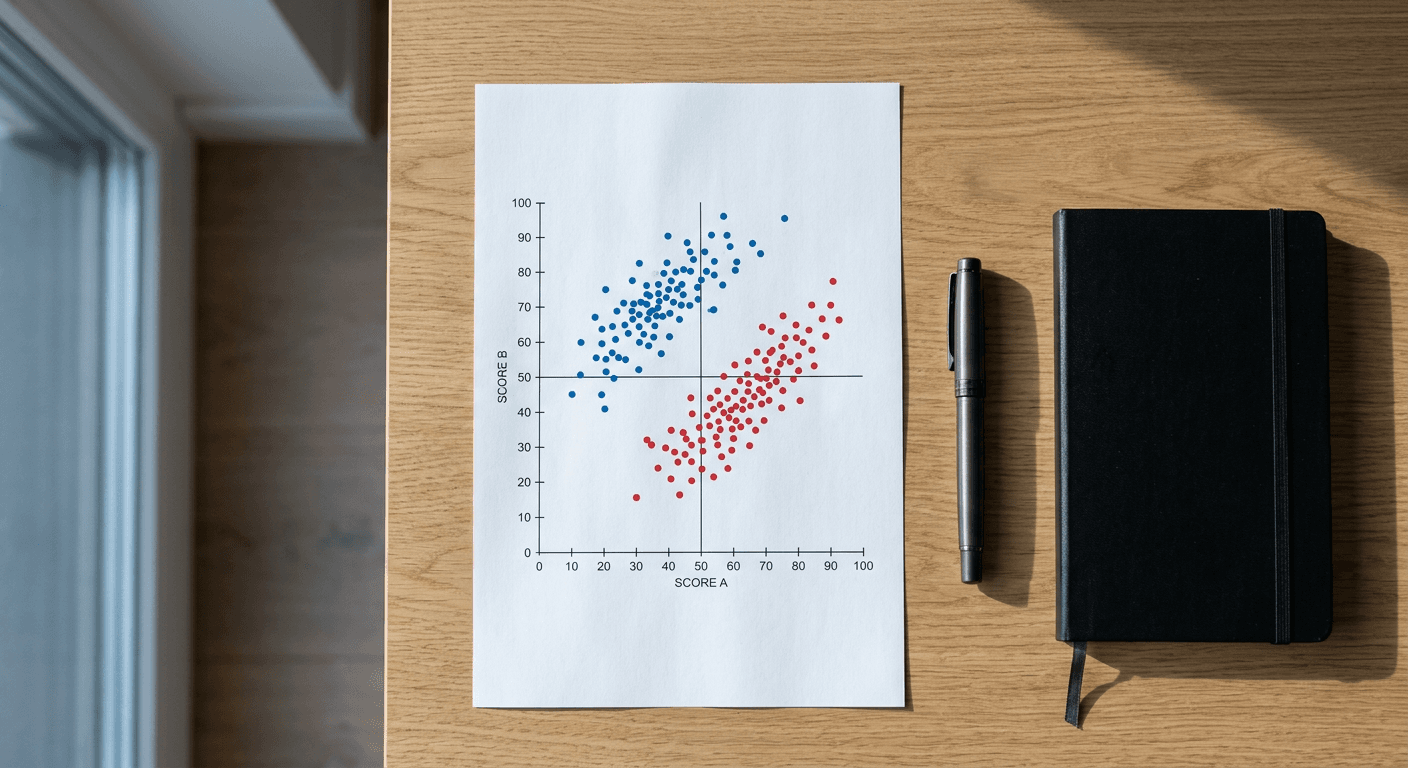
A department director reviews the latest psychometric team matrix and sees a distinct pattern: maximum assertiveness, intense orderliness, and critically low affective compliance. This specific cluster defines the core architecture of the workplace's most polarizing archetype. Grasping the true entj meaning requires abandoning the superficial "Commander" caricature found on social media and examining the actual cognitive mechanics at play. It is not about an inherent desire to lead; it is about a compulsive cognitive need to externalize order and optimize environmental efficiency.
Quick Summary
The ENTJ personality architecture is defined by Extraverted Thinking (Te) and Introverted Intuition (Ni), resulting in a cognitive profile that prioritizes objective systemic efficiency over subjective emotional harmony. In empirical trait models, this maps to high Assertiveness, high Orderliness, and low Agreeableness.
- Core mechanism: Decisions are filtered through external, measurable metrics rather than internal value systems.
- Common failure mode: The "Fi grip," where suppressed affective processing results in volatile, unpredictable emotional outbursts under extreme stress.
- Testing validity: Reliable identification requires dimensional psychometric tools rather than binary, forced-choice questionnaires.
- Compatibility driver: Long-term relationship success depends on complementary cognitive friction, typically found with Ti-dominant (INTP) or Ni-dominant (INTJ) types.
Table of Contents
- The Mechanics of Extraverted Thinking
- How Introverted Intuition Filters Data
- Where the Cognitive Stack Fractures
- Navigating ENTJ Personality Type Compatibility
- Diagnosing the Architecture in Psychometrics
- Calibrating the Instrument
- FAQ
- Recommended Reads
The Mechanics of Extraverted Thinking
The dominant cognitive function for this profile is Extraverted Thinking (Te). Unlike Introverted Thinking (Ti), which seeks internal logical consistency and theoretical purity, Te is entirely oriented toward external application. It organizes the physical and operational world into efficient hierarchies.
When this archetype processes information, they do not ask "does this make logical sense in a vacuum?" They ask "does this work, and how can it be measured?" Affective data - how people feel about a decision - is often discarded during this process not out of malice, but because emotional responses are difficult to quantify and chart. To a Te-dominant user, unquantifiable variables introduce systemic risk.
Practical rule: If a proposed strategy cannot be tracked on a spreadsheet or measured against a Key Performance Indicator, an Extraverted Thinker will view it as operational noise. Always translate relational concepts into systemic outcomes when pitching them.
How Introverted Intuition Filters Data
The auxiliary function, Introverted Intuition (Ni), is what separates this profile from the purely administrative ESTJ. While Sensing-Judging types look to past precedent (Si) to inform their structures, Ni synthesizes disparate data points to project future outcomes.
This creates a specific mechanism: the individual absorbs vast amounts of unstructured environmental data, and the Ni function quietly distills it into a singular, probable trajectory. Te then builds the operational framework to reach that projected future. When someone takes an entj personality test, the instrument is attempting to measure this exact synthesis: the combination of visionary, abstract thinking with aggressive, concrete execution.
However, Ni requires quiet processing time. A common error in managing these individuals is demanding immediate, on-the-spot strategic reasoning. Their dominant Te will quickly formulate a temporary operational fix, but their auxiliary Ni requires latency to calculate the long-term systemic impacts.
Where the Cognitive Stack Fractures
"The individual is being a tyrant" is not a psychological diagnosis - three different internal failures manifest as aggressive rigidity in this profile, and they require completely different interventions. Misdiagnosing the root cause guarantees the intervention will fail.
The Introverted Feeling Grip
Introverted Feeling (Fi) is the inferior function, sitting at the bottom of the cognitive stack. When the individual is under chronic, insurmountable stress that their primary functions cannot solve, they fall into the "Fi grip." The symptom is highly uncharacteristic emotional volatility, hypersensitivity to perceived moral slights, and paranoid isolation.
Check for this by asking: Are they obsessing over a minor interpersonal slight rather than a major structural failure? If yes, you are dealing with an Fi grip. The fix is not to argue logic, as their Te is offline. The fix is physical removal from the stressful environment to let the primary cognitive functions reboot.
The Intuitive-Sensing Loop
When the auxiliary Ni function is bypassed entirely, the individual loops between Extraverted Thinking and Extraverted Sensing (Se). They stop planning and start reacting. The symptom is impulsive decision-making, aggressive micromanagement, and reckless indulgence in sensory experiences (overworking, overspending, or substance abuse).
Check for this by asking: Are they initiating multiple high-risk, short-term projects without their usual long-term risk assessment? If yes, they are looping. The fix is forcing them to articulate the ten-year consequence of their immediate actions, forcibly re-engaging their Ni.
Dominant Function Burnout
This looks like the Fi grip from the outside, but the mechanics are inverted. The individual has simply exhausted their capacity to structure the environment because they refuse to delegate. The symptom is profound lethargy masked by sharp, critical outbursts directed at incompetent subordinates.
Check for this by asking: Have they recently taken over tasks that belong to junior staff? If yes, it is Te burnout. The fix is enforcing mandatory delegation, even if the short-term output suffers.
Navigating ENTJ Personality Type Compatibility
Relationship dynamics for this profile operate on cognitive friction rather than pure affective harmony. Traditional compatibility models fail here because they assume a shared desire for emotional validation. Analyzing entj personality type compatibility requires understanding how Extraverted Thinking interacts with other functional stacks.
The most stable long-term pairings generally occur with INTP (Ti-Ne) or INTJ (Ni-Te) frameworks.
With the INTP, the dynamic is complementary. The INTP provides rigorous, deep-dive internal logic (Ti) that the ENTJ uses to build external systems (Te). The INTP points out the systemic flaws; the ENTJ forces the INTP to actually execute their theories in the real world.
Conversely, pairing with high Extraverted Feeling (Fe) types - such as ESFJs or ENFJs - frequently results in profound communication failure. The Fe-dominant user requires external emotional validation and group harmony; the Te-dominant user views consensus-building as an inefficient waste of time if the underlying logic is flawed. The ENTJ perceives the Fe user as manipulative or overly sensitive, while the Fe user perceives the ENTJ as sociopathic.
Diagnosing the Architecture in Psychometrics
The fundamental flaw in a superficial personality quiz entj seekers take online is the reliance on Barnum statements - vague, universally applicable assertions designed to flatter the reader. A robust assessment must map Jungian cognitive preferences against empirical trait models, specifically the Big Five (OCEAN) and DISC methodologies.
Evaluating these dimensional traits requires taking a scientifically validated psychometric test that measures the actual underlying variables rather than forcing a binary choice. When mapped correctly, the true architectural profile emerges distinctly across different psychological models.
| Assessment Model | Key Dimension | Typical Score/Result for this Profile | Mechanism at Play |
|---|---|---|---|
| Big Five (OCEAN) | Extraversion | High (Assertiveness facet) | Drives the need to command resources and speak first in group settings. |
| Big Five (OCEAN) | Agreeableness | Low (Compliance facet) | Enables the prioritization of objective truth over social harmony. |
| DISC | Dominance (D) | Extremely High | Focuses intensely on shaping the environment to overcome obstacles. |
| Schwartz Values | Power / Achievement | Dominant | Seeks social status, prestige, and control over people and resources. |
Calibrating the Instrument
A rigorous entj personality type test does not rely on self-reported leadership aspirations. High Conscientiousness combined with high Extraversion can frequently mistype an ESTJ or an ENFJ as an ENTJ if the instrument lacks nuance.
The differentiator lies in the Openness to Experience domain in the Big Five model. True ENTJs score highly on the Intellect and Ideas facets of Openness (mapping to their Introverted Intuition), whereas ESTJs generally score lower in this domain, preferring established, proven methodologies. If an instrument cannot parse the difference between "executing a known process efficiently" (Si) and "inventing a new systemic paradigm" (Ni), it cannot validate this archetype accurately.
I strongly advise against using uncalibrated, forced-choice dichotomies for hiring decisions involving this profile. These primitive tools routinely conflate a low score in affective empathy with a low score in cognitive empathy. This archetype often possesses extremely high cognitive empathy - they understand exactly what you are feeling and why - they simply choose not to factor it into the operational equation. Measuring that distinction requires multi-dimensional scaling.
FAQ
What fundamentally drives this cognitive profile? The primary driver is Extraverted Thinking (Te), which creates a psychological compulsion to organize the external environment, optimize systems, and measure objective outcomes against clear metrics.
Why do they frequently struggle with emotional intelligence? Their cognitive architecture places Introverted Feeling (Fi) at the very bottom of their functional stack. They tend to view affective data (emotions) as unreliable, unquantifiable variables that disrupt efficient decision-making, leading to a dismissal of relational nuances.
Which personality profiles create the highest long-term compatibility? Profiles leading with Introverted Thinking (INTP) or Introverted Intuition (INTJ, INFJ) offer the best cognitive friction. INTPs provide theoretical rigor that grounds the execution, while fellow Intuitives match their abstract, future-oriented pacing.
How can you tell if an assessment accurately identified this type? An accurate result requires high scores in Assertiveness (Extraversion) and Orderliness (Conscientiousness), combined with high Intellect/Ideas (Openness) and low Compliance (Agreeableness). If the test cannot measure these distinct facets, the result is likely a misdiagnosis.