The Difference Between MBTI and Scientific Jungian Typology
 Yaro Pry··5 min read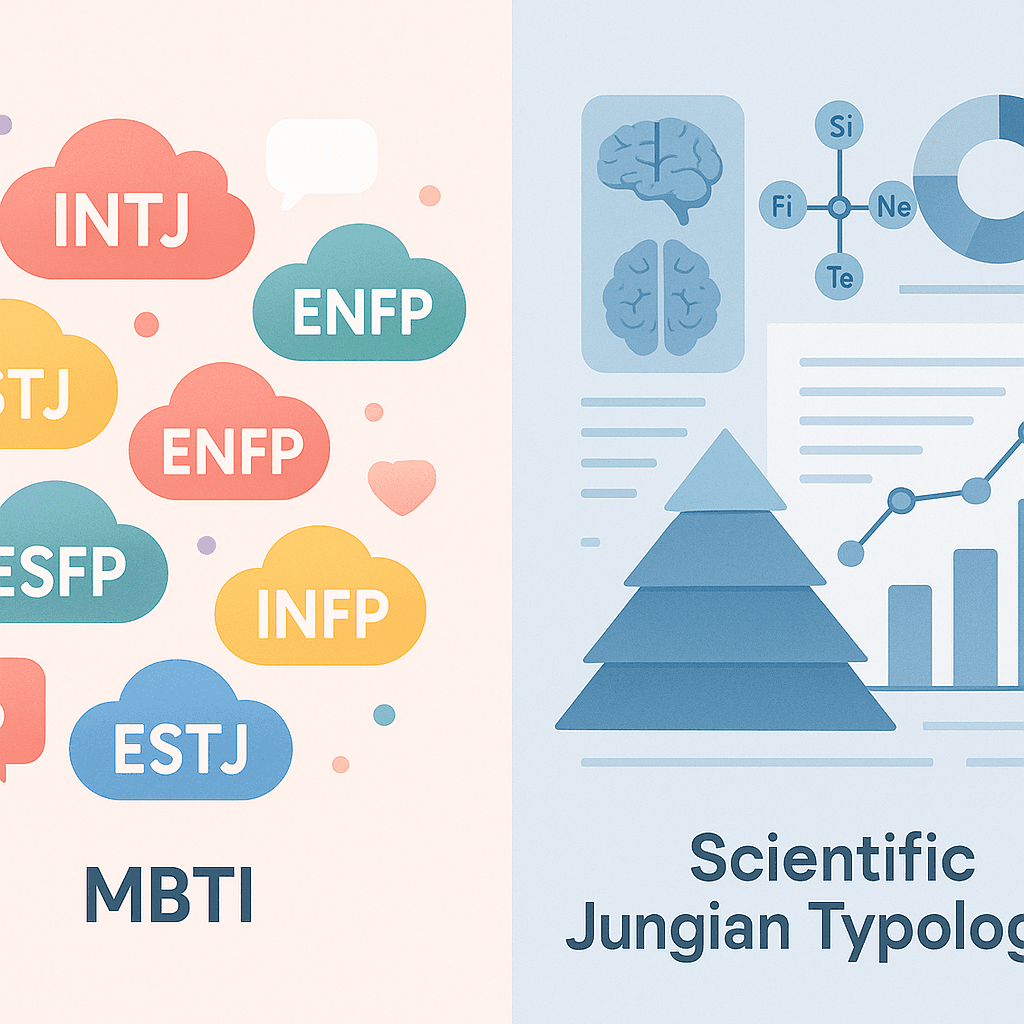
Personality tests are everywhere. Scroll through social media and someone is celebrating their four-letter type like it’s a zodiac sign. Take a career quiz and - surprise - another label appears. It’s catchy. It’s colorful. It feels personal. But here’s the real question: are all personality systems built the same? Spoiler - not even close. When people compare MBTI and scientific Jungian typology, they often assume they’re twins separated at birth. In reality, they’re more like distant cousins who share a last name but live very different lives. One leans toward pop psychology appeal. The other stands firmly on research foundations. Let’s unpack the difference.
What MBTI Actually Is
The Myers-Briggs Type Indicator - better known as MBTI - was developed in the 20th century by Isabel Briggs Myers and Katharine Cook Briggs. It was inspired by Carl Jung’s ideas about psychological types. Inspired. Not identical. MBTI sorts people into 16 personality categories using four dichotomies:
- Introversion (I) vs. Extraversion (E)
- Sensing (S) vs. Intuition (N)
- Thinking (T) vs. Feeling (F)
- Judging (J) vs. Perceiving (P)
Sounds clean and simple, right? Almost too simple. The system assumes people fall primarily on one side of each binary. You’re either this or that. Left or right. Coffee or tea. Here’s the catch - human psychology rarely behaves like a light switch. It’s more like a dimmer.
The Appeal of Four Letters
Let’s be honest. A neat code like "INTJ" feels satisfying. It’s compact. Shareable. Easy to remember. That’s part of its success. Companies use it for team building. Individuals use it for self-reflection. It’s accessible and relatively easy to complete. But popularity doesn’t equal precision. Critics often point to three issues:
- Binary categories - People exist on spectrums, not boxes.
- Test-retest inconsistency - Many users receive different results over time.
- Limited scientific validation - Compared to modern psychometric standards.
That doesn’t make it useless. It just means it shouldn’t be mistaken for rigorous psychological measurement. And this is where scientific Jungian typology enters the conversation.
What Scientific Jungian Typology Really Means
Carl Jung’s original theory of psychological types was deeper and far more nuanced than what most online quizzes suggest. He focused on cognitive functions - how individuals perceive the world and make decisions. Not surface traits. Not personality stereotypes. Internal mental processes. Scientific Jungian typology takes those original concepts and evaluates them using structured, validated psychometric methods. It does not reduce a person to a catchy code without context. Instead, it analyzes cognitive preferences along measurable dimensions. Big difference. Think of MBTI as a simplified map drawn for general navigation. Scientific typology is more like a topographical survey - layered, precise, and data-informed.
Core Features of a Scientific Approach
A research-grounded Jungian system typically includes:
- Scaled measurements instead of rigid binaries
- Statistical validation
- Cross-analysis with other personality models
- Repeatable reliability testing
It respects complexity rather than flattening it. And that matters. Because personality isn’t entertainment. It shapes careers, relationships, leadership style, stress response - even motivation.
Binary Labels vs. Psychological Spectrums
Here’s a hot take: the biggest gap between MBTI and scientific typology is the treatment of nuance. MBTI says you’re Introvert or Extravert. Scientific frameworks ask: where exactly do you fall on the spectrum? How strong is the preference? Does it shift under pressure? How does it interact with emotional intelligence or core values? See the difference? Human behavior is layered. Someone might lean introverted socially but display outward energy in leadership roles. A strict either-or label struggles to capture that. Scientific systems embrace gradients. They treat personality like a mixing board - adjusting levels rather than flipping switches. That shift from binary thinking to dimensional analysis is huge.
The Role of Broader Psychological Models
Modern personality science doesn’t exist in isolation. It overlaps. For example, research-backed platforms like lifematika.com combine Jungian typology with seven additional established methodologies, including:
- OCEAN - the Big Five personality model
- DISC behavioral mapping
- VIA character strengths
- Emotional intelligence metrics
- Self-Determination Theory
- Schwartz’s value framework
- Motivational level analysis
Why does this matter? Because relying on one theory alone is like judging a city by a single street view. Comprehensive assessment reveals intersections - how cognitive preferences align with motivation, strengths, and values. A 95-question structured assessment completed in about 15 minutes can generate an integrated psychological report instantly. No registration hoops. No data selling. Results are private and immediately accessible. That’s the difference between a personality quiz and a psychometric platform.
Reliability and Retesting
One common criticism of MBTI is inconsistency. Studies have shown that a significant percentage of individuals receive different four-letter results upon retesting. That raises eyebrows. Scientific typology systems address this by:
- Using scaled scoring rather than forced choices
- Applying statistical consistency checks
- Allowing users to retake assessments to track changes over time
Personality isn’t frozen. Life events shift perspective. Career changes reshape behavior. Stress alters expression. A strong system acknowledges growth instead of pretending identity is static.
Depth of Insight
MBTI reports often focus on descriptive summaries - strengths, weaknesses, communication style. Useful? Yes. Exhaustive? Not really. Scientific Jungian analysis dives deeper into:
- Dominant and auxiliary cognitive processes
- Behavioral tendencies under stress
- Decision-making frameworks
- Value-driven motivations
- Emotional regulation patterns
That level of detail supports real-life application - career direction, leadership development, conflict resolution. Because self-awareness isn’t about labels. It’s about leverage.
Accessibility vs. Accuracy
Here’s where balance matters. MBTI gained global popularity because it’s digestible. Four letters. Clear explanations. Low barrier to entry. Scientific typology, especially when integrated with broader models, demands more structure. More rigor. Slightly more time. But accuracy requires effort. It’s similar to nutrition. A fast-food meal is quick and satisfying. A carefully prepared balanced plate takes intention - yet delivers better long-term impact. Which approach someone chooses depends on their goal. Casual curiosity? A simplified quiz might suffice. Serious self-development? Research-backed assessment wins.
Privacy and Data Integrity
Another overlooked factor is data handling. Many online personality quizzes collect information without clear transparency. Scientific platforms emphasize confidentiality, using responses solely to generate personal reports. When psychological data is involved, privacy isn’t optional. It’s foundational. Responsible systems protect user information, allow cross-device access, and maintain strict data boundaries. That’s not just technical detail. That’s trust.
So Which One Is Better?
Better for what? If someone wants a fun, accessible entry point into personality discussion, MBTI serves that purpose well. It sparks conversation. It introduces concepts like introversion and cognitive differences. If someone seeks structured, validated insight grounded in multiple psychological frameworks, scientific Jungian typology provides more depth. It measures. It cross-references. It analyzes patterns rather than painting broad strokes. And in a world where decisions - career moves, partnerships, leadership roles - carry real consequences, depth matters.
Final Thoughts on Personality Assessment
Personality systems shape how people see themselves. That’s powerful. A simplified label can feel affirming, but comprehensive insight can be transformative. The difference between MBTI and scientific Jungian typology isn’t about dismissing one and praising the other blindly. It’s about understanding scope. One offers accessible categorization. The other offers structured psychological measurement integrated with broader research. If someone truly wants to understand how they think, decide, relate, and grow - it makes sense to choose tools built on validated science rather than just popularity. Because self-knowledge shouldn’t be a guessing game. It should be informed.