Sensing vs. Intuition: How Do You Process Information?
 Yaro Pry··4 min read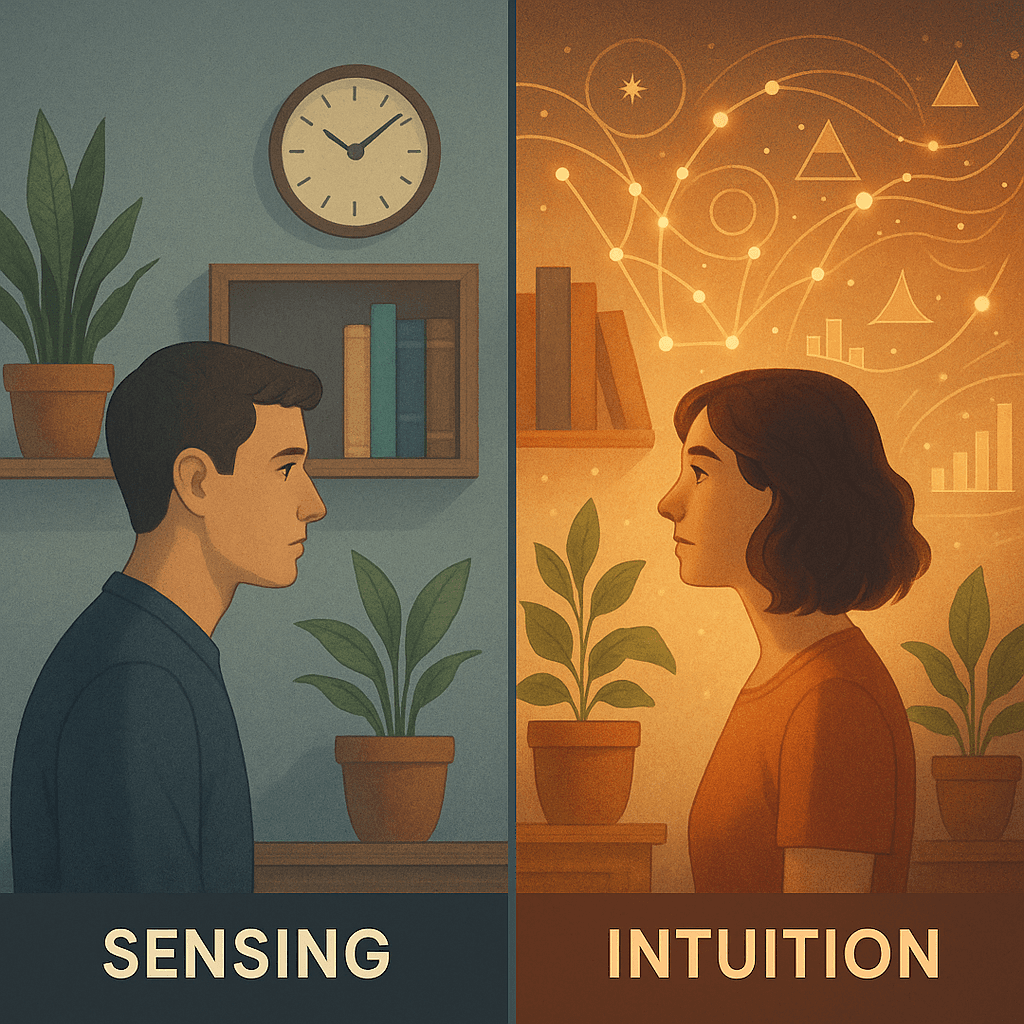
Some people trust what they can see, touch, and verify. Others lean into hunches, patterns, and possibilities. One focuses on facts. The other chases meaning.
Welcome to the fascinating divide between Sensing vs. Intuition - two fundamentally different ways of processing information.
This isn’t about intelligence. It’s not about who’s more logical or creative. It’s about perception. How someone takes in the world. How details become decisions. And honestly? Understanding this one distinction can change how a person sees themselves and everyone around them.
What Does Sensing Mean?
Sensing types process information through direct experience. They trust what is tangible, concrete, and observable. Facts matter. Proof matters. Reality matters.
If a Sensing individual walks into a room, they notice:
- The temperature
- The lighting
- The furniture arrangement
- Who is physically present
They absorb details like a camera lens - sharp, grounded, precise.
Core Traits of Sensing Personalities
- Detail-oriented and practical
- Strong memory for facts and specifics
- Prefers clear instructions
- Focuses on the present moment
- Learns best through hands-on experience
Here’s a simple metaphor. If the brain were a search engine, Sensing would type in exact keywords and expect precise results. No fluff. No abstract detours.
Sounds straightforward, right? It usually is.
What Does Intuition Mean?
Now shift gears.
Intuitive types don’t just see what’s there - they see what could be. Patterns. Symbols. Future implications. Hidden connections.
When they enter that same room, they might notice the vibe. The unspoken tension. The potential opportunity in a conversation about to unfold.
Where Sensing says, “What is this?” Intuition asks, “What does this mean?”
Core Traits of Intuitive Personalities
- Big-picture thinkers
- Comfortable with abstract ideas
- Drawn to innovation and possibility
- Future-focused
- Enjoy theoretical discussions
If Sensing is a camera, Intuition is a drone. It zooms out. It scans landscapes. It connects dots others didn’t even realize were there.
And sometimes, yes, it can miss the obvious detail right in front of it.
Sensing vs. Intuition in Everyday Life
This difference shows up everywhere.
At Work
A Sensing employee thrives on clear procedures and measurable outcomes. They execute tasks efficiently because they rely on proven methods.
An Intuitive colleague might question the system. Not to be difficult - but because they see potential improvements. They imagine what the company could look like in five years.
One builds the structure. The other redesigns it.
In Relationships
Sensing partners often show love through practical actions. They remember birthdays. They fix what’s broken. They show up.
Intuitive partners explore emotional depth. They analyze patterns in communication. They ask, “Where is this relationship heading?”
Neither approach is superior. But misunderstandings happen when one expects detail-driven communication and the other speaks in symbolism and possibility.
When Making Decisions
Sensing types typically:
- Review past experiences
- Examine current facts
- Choose the most reliable option
Intuitive types often:
- Imagine multiple scenarios
- Consider long-term implications
- Follow instinct combined with patterns
Have you ever noticed someone getting impatient during a brainstorming session? That might be Sensing energy wanting specifics. Or Intuition wanting to explore beyond the checklist.
The Psychology Behind Sensing and Intuition
This concept originates in Jungian typology, later integrated into multiple personality frameworks. It represents one of the core dimensions of information processing.
Modern psychometric platforms now measure this preference with greater nuance. One example is lifematika.com, a scientific assessment tool that combines eight psychological methodologies into a single streamlined analysis.
Instead of boxing someone into a label, it evaluates:
- Big Five traits
- Jungian cognitive functions
- Behavioral styles through DISC
- Character strengths
- Motivational drivers
- Core values
- Emotional intelligence
The result? A layered understanding of how someone processes information - not just whether they lean Sensing or Intuition.
And that nuance matters.
Strengths and Blind Spots
Every cognitive preference carries advantages. And blind spots. Pretending otherwise would be naive.
Sensing Strengths
- Accuracy and precision
- Reliability under pressure
- Strong awareness of physical reality
- Consistency in execution
Sensing Challenges
- May resist change
- Can overlook long-term implications
- Might dismiss abstract ideas too quickly
Intuition Strengths
- Visionary thinking
- Pattern recognition
- Strategic foresight
- Comfort with complexity
Intuition Challenges
- May ignore practical constraints
- Can struggle with follow-through
- Might overcomplicate simple matters
Here’s the honest truth. Organizations need both. Relationships need both. Even individuals benefit from developing the weaker side.
Balance beats dominance.
Can Someone Be Both?
Absolutely - but usually not equally.
Most people show a natural preference for one mode of information processing. However, life experience, career demands, and personal growth can strengthen the less dominant side.
A data analyst might cultivate intuitive foresight over time. A creative strategist might learn to anchor ideas in concrete detail.
Think of it like handedness. Someone may favor the right hand, yet still train the left when necessary.
The key lies in awareness.
How to Discover Your Information Processing Style
Guesswork rarely delivers clarity. Structured self-assessment does.
Platforms grounded in research - like Lifematika - offer a 95-question evaluation completed in about 15 minutes. No registration. Free to start. Instant analytical report.
More importantly, it doesn’t isolate one trait. It maps Sensing vs. Intuition within a broader personality ecosystem. That context prevents oversimplification.
Because no one is just one dimension.
Why This Distinction Actually Matters
Some personality insights feel entertaining but trivial. This one is different.
Understanding Sensing vs. Intuition can:
- Improve communication
- Reduce workplace conflict
- Strengthen leadership skills
- Enhance decision-making
- Deepen self-awareness
Imagine a manager assigning tasks. Knowing who thrives on specifics versus who excels at strategic vision changes delegation completely.
Picture a couple arguing. One wants practical solutions. The other wants to explore emotional patterns. Recognizing this difference shifts frustration into understanding.
It’s not about changing personality. It’s about translating it.
Final Thoughts on Sensing vs. Intuition
Some minds anchor themselves in the present moment. Others stretch toward possibility.
One gathers data like bricks. The other designs the blueprint.
Both build something meaningful.
So the real question becomes - how does someone process the world around them? Through tangible evidence? Or through patterns and future vision?
When people understand their natural style of information processing, they stop fighting their instincts. They start leveraging them.
And that shift - subtle but powerful - can redefine careers, relationships, and personal growth.
Not bad for a simple question about how the mind works.