How to Settle the INFP or INFJ Debate Using Cognitive Functions
 Yaro Pry··8 min read
Most people trying to resolve an infp or infj typing dispute stare at the final letter, assuming 'J' implies organized and 'P' implies spontaneous. In psychometric terms, that single letter swap does not represent a minor preference for neat desks versus creative chaos. It represents a complete rewrite of cognitive hardware. You are not looking at two variations of the same empathetic idealist; you are looking at entirely inverted ways of processing reality. When relying solely on behavioral traits, the two types appear indistinguishable. By examining the underlying cognitive functions, the distinction becomes impossible to ignore.
Quick Summary
Resolving the confusion between these two types requires abandoning behavioral stereotypes and examining the underlying cognitive functions that drive decision-making and information processing. While both share intuitive and feeling preferences, they utilize completely different mental frameworks. - INFJs rely on converging internal intuition (Ni) and external emotional consensus (Fe). - INFPs lead with internal emotional authenticity (Fi) and diverging external exploration (Ne). - Analyzing your stress response reliably exposes your inferior cognitive function. - Standard assessments often mistype these profiles by measuring superficial habits rather than processing mechanisms.
Table of Contents
- Quick Summary
- 1. Audit Your Information Processing Pipeline
- Extraverted Intuition Scatters While Introverted Intuition Converges
- 2. Test Your Decision-Making Framework
- Authentic Values Compete With Collective Harmony
- 3. Analyze Your Inferior Function Under Extreme Stress
- Grip Stress Exposes the Hidden Cognitive Weakness
- 4. Evaluate Interpersonal Dynamics and Mirrors
- Contrast Against Opposite Types Clarifies Your Foundation
- 5. Audit Your Assessment Tools
- Standard Assessments Fail at the Introverted Intuition Boundary
- Common Pitfalls & Troubleshooting
- FAQ
- Recommended Reads
1. Audit Your Information Processing Pipeline
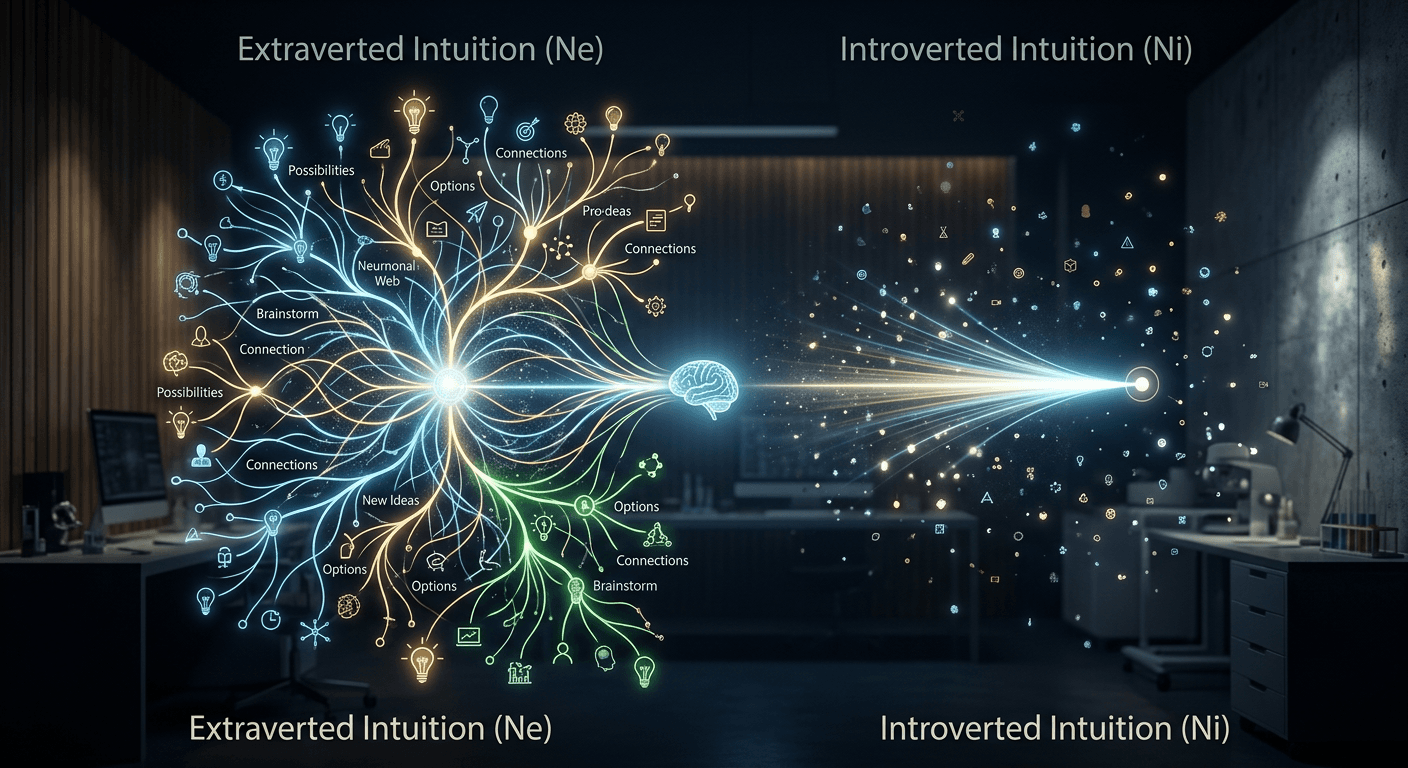
Extraverted Intuition Scatters While Introverted Intuition Converges
Both types are highly intuitive, which means they naturally prioritize abstract concepts, future possibilities, and hidden meanings over immediate sensory data. However, how they handle that abstract information dictates their true type. The INFP uses Extraverted Intuition (Ne) as their secondary function. Ne is an expansive, brainstorming function. It takes a single data point and explodes it into a dozen different possibilities, drawing unexpected connections between seemingly unrelated subjects. The INFJ uses Introverted Intuition (Ni) as their primary function. Ni operates in the exact opposite direction. It takes massive amounts of disparate external data and subconsciously distills it into a singular, overarching pattern or unified theory.
The mistake people make here is equating "thinking about the future" with intuition as a whole, without differentiating the mechanism. An INFP explores the future to keep their options open and revel in possibilities; they often feel constrained if forced to pick just one path prematurely. An INFJ looks at the future to predict the single most likely outcome and formulate a linear plan to navigate it.
Practical rule: If your problem-solving process naturally branches outward into multiple "what if" scenarios that you hesitate to abandon, you rely on Ne; if your mind filters complexity down to one unavoidable "aha" conclusion, you lead with Ni.
To act on this today, track your next creative or strategic project. Measure whether your initial phase involves aggressively narrowing down a thesis statement (Ni) or generating a sprawling mind map that you struggle to cut down (Ne).
2. Test Your Decision-Making Framework
Authentic Values Compete With Collective Harmony
The Feeling preference is another area where superficial similarities mask structural opposites. The INFP leads with Introverted Feeling (Fi). This function makes decisions based on a deeply ingrained, highly personal moral compass. For the INFP, the ultimate metric of a good decision is whether it aligns with their internal authenticity, regardless of how the broader group reacts. The baseline of the infj personality type, however, utilizes Extraverted Feeling (Fe) as its secondary function. Fe is inherently focused on the external emotional environment. It seeks collective harmony, easily reading the room and often prioritizing the needs and feelings of the group over its own internal state.
The common error is assuming empathy looks the same for both. When an INFP demonstrates empathy, they are usually mirroring: they dive into their own vast emotional memory, find a time they felt something similar, and project that deep understanding onto the other person. When an INFJ demonstrates empathy, they are absorbing: they literally feel the emotional temperature of the person in front of them, sometimes losing track of where their own emotions end and the other person's begin.
You can test this dynamic by observing your immediate reaction to an uncomfortable social situation, like a highly offensive joke told at a dinner party. An Fi user will immediately register an internal violation of their core values and will likely speak up or withdraw based on that internal breach. An Fe user will first register the sudden, sharp tension in the room, focusing on how the joke impacted the group's harmony before processing their own moral stance on it.
3. Analyze Your Inferior Function Under Extreme Stress
Grip Stress Exposes the Hidden Cognitive Weakness
Cognitive psychology dictates that under chronic or extreme stress, the dominant functions exhaust themselves, and the psyche falls into the "grip" of the inferior, weakest function. Because these two types have completely different functional stacks, their psychological breakdowns look entirely different. Identifying your stress response is one of the most reliable ways of learning how to identify and navigate your profile among the 16 MBTI types because it bypasses the behaviors you consciously control.
For the INFP, the inferior function is Extraverted Thinking (Te). Normally adaptable and tolerant, a severely stressed INFP becomes rigidly dictatorial. They obsess over facts, logic, and harsh efficiency, lashing out at others for perceived incompetence or disorganized systems. They attempt to aggressively control their external environment to compensate for internal chaos. For the INFJ, the inferior function is Extraverted Sensing (Se). A severely stressed INFJ abandons their normally disciplined, future-oriented planning and falls into reckless sensory bingeing. This manifests as overeating, impulse shopping, substance abuse, or suddenly hyper-focusing on minute physical details in their environment like obsessively cleaning a single room.
The failure mode here is confusing everyday anxiety with a true grip state. Having a messy desk when you are busy does not mean you are in an Se grip, and making a schedule because you are overwhelmed does not mean you are in a Te grip. You must look for the distinct, uncharacteristic extreme that leaves you feeling out of character. Document your worst mental health week from the past year. Did you become a cold, hyper-critical tyrant (Te), or did you numb out with excessive physical indulgence (Se)?
4. Evaluate Interpersonal Dynamics and Mirrors
Contrast Against Opposite Types Clarifies Your Foundation
We rarely operate in a vacuum. The cognitive functions we possess naturally seek out complementary functions in others. By analyzing the company you keep and the communication styles that make you feel energized versus drained, you can reverse-engineer your own type.
Consider the recognized infj-enfp dynamic. INFJs often find themselves deeply drawn to Extraverted Intuition dominant types like the ENFP. The ENFP provides a constant stream of external possibilities (Ne), which perfectly feeds the INFJ's desire to filter and synthesize information (Ni). The interaction feels electric because one expands while the other distills. If you read about ENFP personality: traits and compatibility and find that you naturally provide the grounding synthesis to their chaotic brainstorming, you are likely leaning on Ni. INFPs, conversely, share the ENFP's Ne. Two Ne users in a room will generate a million ideas but often struggle to finalize one. INFPs frequently find better complementary balance with strong Extraverted Feeling or Extraverted Thinking types (like ENFJs or ENTJs) who can provide structure to the INFP's internal emotional depth.
The mistake individuals make during this step is typing themselves based on the traits of their romantic partner or a dominant parent, a phenomenon known as cognitive mirroring. Evaluate your interactions across multiple friend groups and professional environments, noting whether you consistently play the role of the divergent brainstormer or the convergent synthesizer.
5. Audit Your Assessment Tools
Standard Assessments Fail at the Introverted Intuition Boundary
Much of this typing confusion stems from the tools people use to measure themselves. Taking a standard infp personality test usually means answering dichotomous questions based on the four-letter framework. These tests ask behavioral questions like, "Do you prefer a tidy workspace?" or "Do you stick to a schedule?" to determine the Judging (J) versus Perceiving (P) axis.
This approach fundamentally misunderstands how introverted cognitive functions manifest in the physical world. An INFJ's primary function (Ni) is introverted and perceiving. This means their internal world is often fluid, abstract, and unconstrained. Their "Judging" function (Fe) is secondary and directed outward. Therefore, an INFJ might have a messy bedroom but demand strict interpersonal harmony. An INFP's primary function (Fi) is introverted and judging. Their internal world is incredibly structured around rigid values, but their outward-facing function (Ne) is perceiving. Thus, an INFP might appear totally spontaneous to the outside world while remaining inflexible on internal principles.
When you take a casual infj personality quiz online, you are likely answering questions about your learned habits, which are heavily influenced by your job, your upbringing, or trauma. To genuinely break the tie when searching for a definitive infp or infj test, you must evaluate the 5 frameworks for a reliable personality and career test that specifically measure cognitive functions rather than environmental habits. Look back at the last assessment you took and audit the questions you hesitated on. If a question asked about organization and you thought, "I organize my thoughts but not my desk," the test is failing to measure your actual processing style.
Common Pitfalls & Troubleshooting
Diagnosing a mistype requires looking past the surface behaviors to the root causes. The following distinct failures often look identical from the outside but require different approaches to resolve.
Symptom: You consistently score exactly 50/50 on the P and J axis across multiple tests. Diagnosis: You are answering questions based on professional conscientiousness rather than cognitive preference. Workplaces heavily reward Judging behaviors (deadlines, schedules, strict organization). Fix: Stop looking at your behavior in the office. Evaluate how you structure your time on a completely free weekend with zero external obligations. If you inherently plan the day, lean J. If you see where the wind takes you, lean P.
Symptom: You feel like a chameleon in social settings, altering your personality to match the group, which makes you suspect you have strong Extraverted Feeling (Fe). Diagnosis: You are conflating trauma-based masking with natural cognitive processing. People who grew up in volatile environments learn to read the room to stay safe, which mimics Fe. Fix: Distinguish between defense mechanisms and baseline processing. How to find your true personality type means asking yourself if adapting to the room energizes you (Fe) or exhausts you while you secretly judge the group's authenticity (Fi).
Symptom: You possess high organizational skills and long-term ambition but strongly relate to the INFP descriptions of deep, poetic emotional resonance. Diagnosis: The Barnum effect. INFP descriptions are universally appealing because they describe human emotional depth. Most people want to view themselves as deep, authentic, and morally grounded. Fix: Ignore the flattering descriptions of the types. Read about their absolute worst traits - the grip stress, the blind spots, and the interpersonal failures. You will instantly recognize your true type by which negative description makes you feel the most defensive and exposed. This is the most frequent cause of persistent mistyping.
FAQ
Can you be both an INFP and an INFJ depending on your mood? No. In psychometric models based on cognitive functions, the structural stacks are mutually exclusive. While your behavior fluctuates daily based on mood, stress, and environment, your baseline method for processing information (Ni vs Ne) and making value judgments (Fe vs Fi) remains constant. You can adopt the behaviors of another type, but you cannot change your dominant cognitive hardware.
Why do standard personality tests struggle with these two types? Standard tests rely on dichotomies (E vs I, S vs N, T vs F, J vs P) and ask behavioral questions designed to measure trait conscientiousness to determine the J/P axis. Because an INFJ's dominant function is actually perceiving (Ni) and an INFP's dominant function is actually judging (Fi), questions about desk organization and calendar use often return false positives. You need finding the best MBTI test: a 2026 guide to personality assessment accuracy that evaluates cognitive function strength rather than behavioral habits.
Does being messy automatically make me an INFP? No. Environmental orderliness is not inherently tied to Introverted Feeling or Extraverted Intuition. Many INFJs are chronically messy in their physical environments because their dominant Introverted Intuition keeps them entirely in their own heads, disconnected from physical reality (inferior Se).
How does the INFJ handle conflict compared to the INFP? An INFJ managing conflict uses Extraverted Feeling, attempting to mediate, soothe the emotional environment, and find a compromise that restores group harmony, often sacrificing their own immediate needs. An INFP uses Introverted Feeling, standing their ground on issues that violate their core moral values, and will often withdraw entirely rather than agree to a compromise they view as inauthentic or ethically wrong.